




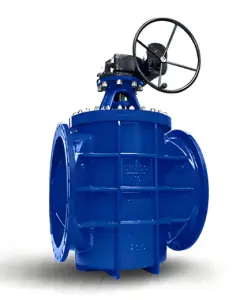
In water supply, wastewater, and pumping systems, an AWWA C517 Plug Valve is often matched first by DN, pressure rating, and connection type. These parameters confirm basic compatibility, but they do not fully explain how the valve will behave once fluid begins to flow through it. For an eccentric plug valve, port geometry can directly influence local velocity, pressure loss, hydraulic loading, and the passage of suspended solids.
Even when two AWWA C517 Plug Valves are both DN300, their effective flow areas may differ. DN describes the nominal connection size, not the exact internal opening. Plug profile, body geometry, minimum clearance, and the transition through the valve all contribute to hydraulic performance.
A useful way to understand the relationship is:
Flow area determines how much the fluid must accelerate, port geometry determines how that acceleration occurs, and Cv/Kv reflects the combined hydraulic result of the complete valve.
Why Does DN Not Represent the Actual Flow Area of an AWWA C517 Plug Valve?
Consider a DN300 pipeline fitted with a DN300 AWWA C517 Plug Valve. The connection sizes match, but once the fluid enters the valve body, it does not necessarily continue through a circular passage identical to the pipe bore.
The plug occupies part of the internal space, while the body must also accommodate the shaft, sealing system, and supporting components. As a result, the minimum effective flow area can be smaller than that of the adjacent pipe.
The basic relationship between flow rate, area, and velocity is:Q = A × V
where Q is flow rate, A is effective flow area, and V is average velocity. If the flow rate remains constant, reducing the effective area increases local average velocity.
| Effective Flow Area vs. Pipe Area | Relative Average Velocity |
|---|---|
| 100% | 1.00 |
| 80% | 1.25 |
| 60% | 1.67 |
If the effective flow area of an AWWA C517 Plug Valve is only 80% of the pipe cross-sectional area, the idealized average velocity through the valve increases by about 25%. If the area falls to 60%, the velocity may reach approximately 1.67 times the pipe velocity.
The key point is that identical DN values indicate the same nominal connection size, not identical internal hydraulic conditions.
Why Port Area Alone Cannot Predict Pressure Loss
A smaller port normally increases local velocity, but pressure loss does not increase in a fixed ratio with area reduction.
Fluid entering a Plug Valve may contract, accelerate, change direction, and then expand before returning to the downstream pipe. A smooth transition can limit turbulence, while an abrupt contraction followed by rapid expansion can create flow separation and greater irreversible energy loss.
This means two valves with similar port areas can still have different pressure drops.Four parameters are particularly useful when evaluating flow performance:
- DN / NPS: connection size;
- Effective Port Area: available internal flow space;
- Port Geometry: the actual flow path around the plug;
- Cv / Kv: overall flow capacity of the complete valve.
Port area explains why velocity changes. Cv/Kv gives a more useful indication of the hydraulic result produced by the complete internal geometry.
A Simple Example: Same DN, Different Hydraulic Behavior
Assume two valves are installed in the same DN300 pipeline at the same design flow.Valve A has a relatively large opening and smooth internal transitions. Valve B has a smaller minimum opening and a sharper contraction around the plug.
The first change inside Valve B is higher local velocity. That acceleration changes the pressure distribution around the plug. Contraction, expansion, plug profile, and turbulence then determine how much energy is lost before the fluid returns to the downstream pipe.The final difference appears in Cv/Kv and pressure drop.
In other words:Port area is one cause; pressure loss is the result of the entire internal flow field.
This is why an “80% port” description alone cannot fully define valve performance.
Cv/Kv Shows Differences That DN Cannot
Two DN300 valves may look almost identical on a dimensional drawing but have different full-open Cv/Kv values. At the same flow rate, the valve with greater flow capacity will generally require less differential pressure.
The difference may come from a larger opening, smoother transitions, a different plug profile, or several factors working together.
A useful datasheet comparison therefore looks beyond DN:
| Parameter | Main Information |
|---|---|
| DN / NPS | Connection size |
| Pressure Rating | Structural pressure capability |
| Effective Port Area | Internal flow space |
| Minimum Clear Opening | Clearance available for solids |
| Port Geometry | Actual internal flow path |
| Cv / Kv | Overall flow capacity |
| Design Flow | System flow requirement |
| Pressure Drop | Hydraulic loss across the valve |
DN and pressure rating mainly indicate whether the valve is structurally compatible with the pipeline. Port geometry, Cv/Kv, and design flow indicate how it will behave once installed.
Higher Velocity Also Changes Hydraulic Loading
When fluid accelerates through a restricted passage, the pressure and velocity distribution around the plug changes. This can alter hydraulic forces acting on the plug and shaft.
The effect becomes more important when the valve is partially open because the plug further restricts the passage and redirects the flow. Operating torque therefore cannot be treated as a completely fixed mechanical value. Flow rate, differential pressure, and valve position can all influence the load acting on the closure element.
In wastewater containing sand or abrasive particles, higher local velocity can also increase the severity of particle impact on coatings and internal metal surfaces. Actual wear still depends on particle concentration, hardness, impact angle, and material properties, but high-velocity regions deserve greater attention in abrasive service.
Effective Port Area and Minimum Clear Opening Are Different
For clean water, total flow area is a major hydraulic consideration. In wastewater, however, another dimension becomes important: the smallest opening through which solids must pass.
Two valves can both have an effective port area equal to 80% of the pipe area while having very different internal shapes. One may provide a broad open passage, while another contains a narrow local section.
Water may flow adequately through both, but fibers, soft solids, or larger debris may behave differently.
Three terms should therefore be separated:
- Effective Port Area: total flow area;
- Minimum Clear Opening: smallest physical passage;
- Port Shape: how that opening is distributed.
A high port-area percentage does not automatically mean better solids passage. For wastewater systems, minimum clearance can sometimes be as important as total area.
Why the Largest Port Is Not Always the Best Design
A larger opening can reduce local velocity and hydraulic resistance, but valve design involves more than maximizing flow area.
The plug must retain sufficient mechanical strength, the shaft needs reliable support, the seat must maintain stable sealing geometry, and the body must withstand the required pressure. Increasing the port area changes the space available for all these components.
Port design is therefore a balance between:
- Flow capacity;
- Pressure loss;
- Mechanical strength;
- Sealing reliability;
- Solids passage.
A full-port or high-port-area design can be beneficial, but it should not be treated as a universal measure of valve quality.
The better question is whether the flow path provides suitable hydraulic performance at the required design flow while maintaining the valve’s structural and sealing functions.
Why Pipe Velocity and Valve Velocity May Be Different
Pipeline velocity is normally calculated from pipe diameter and flow rate. If a DN300 pipe operates at an average velocity of 2 m/s, that value describes the pipe.
If the valve has a smaller effective opening, fluid must accelerate as it enters the port. Therefore:
Pipe Velocity ≠ Valve Local Velocity
This distinction becomes more important in high-flow pump stations and transmission mains, where local acceleration can increase pressure loss, hydraulic forces, and internal wear.
Pressure rating and hydraulic performance should therefore be evaluated separately. One describes structural capability; the other describes how the valve affects moving fluid.
FAQ
1. Does an AWWA C517 Plug Valve Have the Same Flow Area as the Pipe?
Not necessarily. DN describes nominal connection size, while actual flow area depends on plug profile, body geometry, and internal port design.
2. Does Pressure Loss Increase Directly as Port Area Decreases?
No. Smaller area increases local velocity, but actual pressure loss also depends on contraction, expansion, plug geometry, and turbulence.
3. Why Is Cv/Kv More Useful Than Port Area Alone?
Port area describes available space, while Cv/Kv reflects the combined hydraulic effect of the complete valve geometry.
4. Why Is Minimum Clear Opening Important in Wastewater?
Because suspended solids, fibers, and debris may be limited by the narrowest part of the flow path even when total port area is relatively large.
Conclusion
The same DN does not guarantee the same hydraulic performance in an AWWA C517 Plug Valve. Effective flow area affects local velocity, port geometry determines how the flow contracts and expands, and Cv/Kv reflects the combined hydraulic result.
For wastewater systems, minimum clear opening and solids passage also deserve attention. The more useful question is therefore not simply whether the valve matches the pipeline size, but how fluid will move through the valve at the actual design flow and how much hydraulic resistance the valve will add to the complete system
Post time: Aug-18-2026