




The requirements placed on valves in large-diameter water supply and drainage pipelines go far beyond simply opening and closing the flow. As pipeline diameter increases, the hydraulic force acting on the disc, stem torque, sealing load, and the effects of pressure variation all become more significant. Once a valve develops internal leakage, excessive operating torque, or accelerated seat wear, the consequences may affect an entire transmission line, pumping station, or treatment system rather than a single piece of equipment.
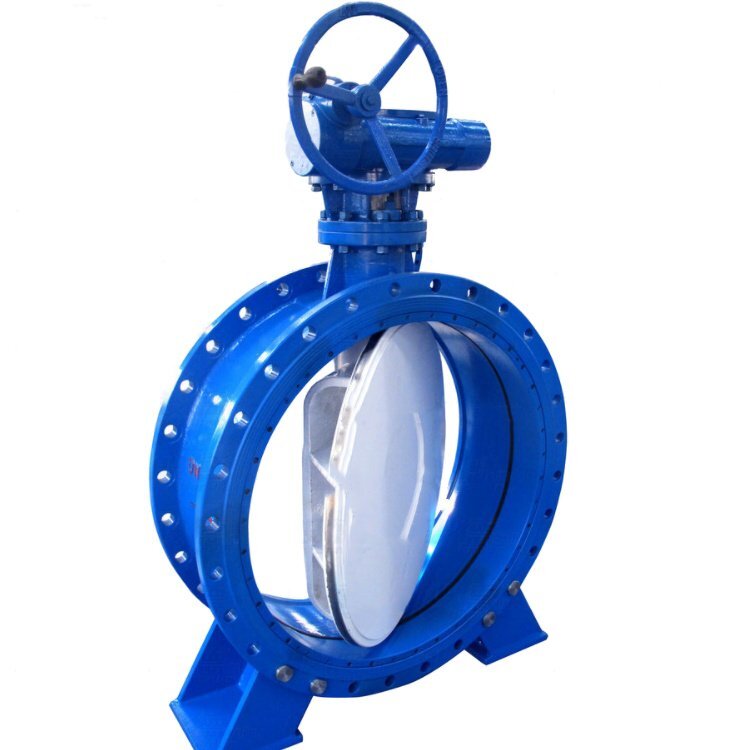
A Double Eccentric Flanged Butterfly Valve uses an optimized geometric relationship between the stem, disc, and valve body. This allows the disc to separate from the seat more quickly during the initial opening stage and gradually establish sealing pressure during final closure. Compared with a concentric butterfly valve, this movement reduces continuous friction during operation, making the valve more suitable for large diameters, frequent operating cycles, and water systems requiring long-term reliability.
Large-Diameter Valve Design Is More Than Simply Scaling Up the Size
Simply enlarging a small valve does not automatically produce reliable large-diameter performance. As valve size increases, the disc surface area becomes larger, and the hydraulic torque acting on the disc rises accordingly. At the same time, the stem, bearings, seat, and actuator must withstand greater mechanical loads.
Common technical challenges in large-diameter pipeline valves include:
- Excessive operating torque and increased actuator load;
- A larger friction area between the disc and seat, accelerating seal wear;
- Uneven disc loading under high differential pressure;
- Vibration or unstable operation caused by pressure changes;
- Difficulty reopening after extended periods in the closed position;
- Internal leakage following sealing-surface damage;
- High cyclic loads on the stem, bearings, and gearbox.
For this reason, the design of a large butterfly valve must consider disc movement, sealing structure, shaft strength, operating torque, and pipeline hydraulics together. Nominal diameter and connection dimensions alone are not enough to determine whether a valve is suitable.
How Does the Double Eccentric Design Change Disc Movement?
In a concentric butterfly valve, the stem generally passes through the center of the disc. During rotation, the disc continuously compresses or rubs against the resilient seat. This structure is simple and suitable for many general water applications. However, as valve size, operating frequency, or closing differential pressure increases, friction at the sealing interface becomes more significant.
A double eccentric butterfly valve changes the disc movement through two geometric offsets.
The first offset positions the stem axis away from the center of the disc sealing surface. The second positions the stem axis away from the centerline of the valve body or pipeline. Together, these offsets create a cam-like movement during disc rotation.
As soon as the valve begins to open, the disc sealing ring moves away from the seat relatively quickly instead of continuing to rub against it throughout the full rotation. During closing, the disc approaches the seat and gradually applies the required sealing pressure near the fully closed position.
The main technical benefit is not the complete elimination of friction. Instead, sealing contact is limited mainly to the final part of the closing stroke, reducing wear throughout most of the opening and closing cycle.
The Sealing Pair Determines Long-Term Shutoff Performance
The closing reliability of a butterfly valve depends on whether the disc seal, valve seat, stem positioning, and actuator can work together to maintain a stable closed position.
Double eccentric butterfly valves used in water supply, drainage, and treatment systems commonly employ resilient sealing structures. Rubber seats can compensate for limited manufacturing tolerances and installation deformation while creating a continuous seal when the disc closes. For industrial pipelines involving higher temperatures, corrosion, or abrasive conditions, other elastomeric or metal sealing structures may be used according to the service conditions.
If excessive torque is required to force the valve into a sealed position, the sealing material may be over-compressed, accelerating aging and permanent deformation. A professional valve design should balance reliable shutoff performance with the service life of the sealing components.
Why Does Lower Operating Torque Matter for Large Valves?
Large-diameter butterfly valves are commonly equipped with worm gearboxes, electric actuators, pneumatic actuators, or hydraulic actuators. As the required valve torque increases, the actuator size, installation space, and operating load also increase.
The double eccentric structure reduces friction between the disc and seat, helping lower sealing-related torque. However, actual operating torque is also affected by:
- Pipeline working pressure and closing differential pressure;
- Disc diameter and structural design;
- Flow velocity and direction;
- Stem bearing friction;
- Seal material hardness;
- Static friction after extended periods without operation;
- Sediment or impurities inside the pipeline;
- Gearbox transmission efficiency.
Therefore, actuator sizing should not be based on nominal diameter alone. Maximum differential pressure, required operating time, control method, and an appropriate safety factor must also be considered.
In pumping stations and treatment systems where valves operate frequently, lower and more consistent torque reduces actuator load and improves the repeatability of automatic control.
Hydraulic Forces Acting on the Disc Must Also Be Controlled
The disc of a butterfly valve remains inside the flow passage even when the valve is fully open. As a result, the disc and stem still influence local resistance, flow distribution, and hydraulic torque.
If a butterfly valve is continuously used for throttling at a small opening angle, high local velocity and differential pressure may develop around the disc. This can cause vibration, noise, local erosion, or cavitation.
Although a double eccentric butterfly valve may be used for a certain range of flow regulation, the system design must determine whether the valve will mainly be used for isolation, sectional control, or continuous throttling.
In large water transmission pipelines where isolation is the primary function, the valve normally operates in either the fully open or fully closed position. When fully open, flow resistance should be minimized. When fully closed, reliable shutoff must be maintained.
Why Is a Flanged Structure Suitable for Large Pipeline Projects?
A flanged valve body is connected to pipeline flanges with bolts, providing a stable installation interface for large valves. Compared with some more compact connection types, flanged connections offer better positioning, easier removal, and more practical maintenance access.
The engineering advantages of flanged construction include:
- Stable connection between the valve and pipeline;
- Easier dismantling and servicing in valve chambers or pump rooms;
- Compatibility with different pipeline flange standards;
- Better control of sealing conditions at the connection points;
- Suitability for heavy valves with larger or more complex actuators;
- Easier integration with dismantling joints, expansion joints, and related fittings.
However, flanged connections do not automatically correct pipeline installation errors. The upstream and downstream flanges must maintain suitable alignment and parallelism. Bolts should be tightened gradually and evenly in a cross pattern.
Using flange bolts to force misaligned pipes into position may transfer additional stress to the valve body, affecting disc alignment, operating torque, and sealing performance.
Protective Coating Is More Than an Appearance Issue
Underground networks, valve chambers, and water treatment facilities are often highly humid. The external surface of the valve may be exposed to soil, moisture, or standing water, while internal surfaces remain in continuous contact with the conveyed medium.
If the coating contains pinholes, incomplete coverage, or areas of poor adhesion, corrosion may begin locally and gradually spread.
Epoxy coating is commonly used to protect the internal and external surfaces of water and wastewater valves. Its effectiveness depends on surface preparation, coating thickness, curing quality, and coverage around edges and complex geometries.
Areas that often require particular attention include:
- Disc edges;
- Regions near flange faces;
- Bolt holes;
- Corners and recessed surfaces;
- Complex transitions in the valve body.
For valves installed underground or in damp chambers for extended periods, corrosion protection is just as important as mechanical design.
Which Systems Are Better Suited to Double Eccentric Flanged Butterfly Valves?
These valves are especially suitable for systems requiring high flow capacity, reliable sectional isolation, and relatively low maintenance frequency.
Municipal Water Transmission and Distribution Networks
They can be used for main pipeline isolation, network zoning, and inlet or outlet pipelines at water treatment plants. Large valves must remain operable after long periods of inactivity and limit internal leakage when closed.
Pumping Stations
They can be installed at pump inlets and outlets, manifold pipelines, and zoned pipeline sections. Valve operation should be coordinated with pump start-up and shutdown procedures to avoid rapid closure under unsuitable velocity or differential pressure conditions.
Water Treatment Facilities
They are suitable for sedimentation, filtration, backwashing, and clean-water transmission lines. Stable operation helps maintain hydraulic separation between different treatment stages.
Industrial Circulating Water Systems
Cooling-water and circulating-water systems often carry high continuous flow rates. Valves must combine low flow resistance, reliable isolation, and compatibility with automated control.
Wastewater Transmission Systems
When used in wastewater treatment facilities and pressurized drainage lines, sealing materials and internal structures should be selected according to suspended solids, corrosive components, and sediment conditions.
RMT Double Eccentric Flanged Butterfly Valve for Pipeline Applications
RMT focuses on valves and pipe fittings for water supply, drainage, wastewater treatment, pumping stations, and industrial water systems. Double Eccentric Flanged Butterfly Valves can be configured according to pipeline pressure rating, flange standard, medium condition, actuation method, sealing material, and corrosion-protection requirements.
In large-diameter pipelines, valve performance should not be evaluated by nominal size alone. Disc movement, closing differential pressure, actuator torque, seat material, shaft strength, and installation conditions all influence long-term operating results.
FAQ
1. Why Does a Double Eccentric Butterfly Valve Have Less Friction Than a Concentric Butterfly Valve?
The stem axis is offset from both the center of the disc sealing surface and the centerline of the valve body. This allows the disc to move away from the seat quickly when opening, reducing continuous friction during most of the rotational movement.
2. Can a Double Eccentric Butterfly Valve Be Used for Continuous Flow Regulation?
It can be used within a certain regulating range, but suitability for continuous throttling depends on differential pressure, flow velocity, opening angle, and cavitation risk. Many large water systems primarily use these valves in fully open or fully closed isolation service.
3. Why Are Large-Diameter Butterfly Valves Usually Equipped with Gearboxes or Actuators?
Operating torque increases with valve size and closing differential pressure. A gearbox or actuator provides stable output torque while controlling valve position and opening or closing speed.
4. Can Flange Misalignment Affect Butterfly Valve Sealing?
Yes. Flange misalignment and pipeline stress can deform the valve body, shift the disc position, or create uneven seat loading. This may increase operating torque and reduce shutoff performance.
Conclusion
Large-diameter water pipelines require butterfly valves with suitable hydraulic performance, sealing design, shaft strength, actuator torque, corrosion protection, and installation accuracy.
The Double Eccentric Flanged Butterfly Valve improves disc movement by reducing sealing friction during operation and establishing stable contact near the fully closed position. This makes it particularly suitable for large water supply and drainage systems requiring long-term reliability.
Its actual performance does not depend on the term “double eccentric” alone. Disc-to-seat alignment, material configuration, actuator sizing, and installation quality all contribute to the final operating result. Only when the valve structure is properly matched with pipeline pressure, flow rate, medium, and operating method can the technical advantages of the double eccentric design be fully realized.
Post time: Jul-30-2026