




In wastewater treatment, pumping stations, and industrial water systems, the value of an Eccentric Plug Valve is not limited to opening and shutting off a pipeline. What matters more is whether the valve can still maintain stable operating torque, reliable sealing, and practical maintainability after years of service.
Wastewater conditions can create problems that are less obvious in clean-water systems. Sand, sludge, fibers, and suspended solids may enter different moving areas, while long periods of inactivity can allow deposits to accumulate. As these factors gradually affect the seat, shaft, bearings, and internal flow passage, a valve that initially worked normally may slowly become more difficult to operate.
This is one of the main reasons why Eccentric Plug Valves are used in wastewater pipelines. By changing the movement relationship between the plug and seat, the eccentric design reduces continuous friction throughout the operating stroke instead of waiting until leakage or actuator overload becomes a problem.
Why Does an Eccentric Plug Valve Need Close Attention to Operating Torque?
For many wastewater valves, the first sign of a developing problem is not leakage but a gradual increase in operating torque. A manually operated valve may feel heavier through the gearbox, while an automated valve may take longer to open or close, operate closer to the actuator torque limit, or occasionally fail to complete the full stroke.
This change is usually caused by several factors rather than one single problem. Particles may enter moving areas, deposits may build up, packing resistance may change, bearings may become contaminated, and sealing surfaces may begin to wear.
In a conventional arrangement, if the plug or closure element remains under significant contact pressure against the seat through a large part of the operating stroke, friction continues to build during every cycle. In an Eccentric Plug Valve, the plug moves away from the seat relatively early during opening and returns to major sealing contact only near the end of closing.
This structure cannot eliminate wear completely, but it reduces one important long-term issue: continuous sliding of loaded sealing surfaces.
How Does an Eccentric Plug Valve Help Reduce Seat Wear?
Sealing-surface deterioration often begins long before visible leakage appears.
If sand or hard particles enter the area between the plug and seat, they may act like abrasive material during each valve cycle. In the early stages, the resilient sealing system may still maintain shut-off performance, so the problem can remain unnoticed.
As wear continues, however, the original contact condition begins to change. The valve may require more closing force to achieve the same sealing result, and eventually the contact surface may become uneven.
An Eccentric Plug Valve does not address this problem simply by increasing sealing pressure. Instead, it reduces unnecessary contact time between the plug and seat, helping slow the accumulation of wear. This is particularly useful in wastewater, treatment systems, and pipelines carrying suspended solids.
Wastewater Service Challenges More Than the Valve Seat
Focusing only on the seat can underestimate how strongly wastewater affects the entire valve.
Larger solids can influence the internal flow passage, fine sand may reach the shaft and bearing areas, and fibers may accumulate around local internal structures. During low-flow periods or extended shutdowns, deposits can also build on internal surfaces and increase resistance when the valve is operated again.
For wastewater Eccentric Plug Valve applications, several areas deserve attention:
- Protection of the shaft and bearing system;
- Internal geometry that reduces material accumulation;
- Materials suitable for the actual medium;
- Additional internal wear or corrosion protection where required.
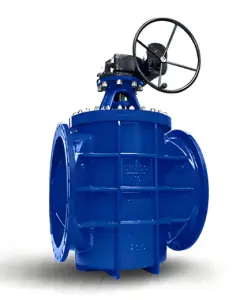
RMT’s Eccentric Plug Valve uses T316 stainless steel radial bearings and a lower thrust bearing. Depending on project requirements, internal protection options may include epoxy coating, fusion-bonded epoxy, glass lining, or rubber lining.
There is no single internal protection solution suitable for every wastewater application. Treated water, sand-containing sewage, and chemically aggressive industrial wastewater may require different configurations even when the valve size is the same.
Why Do Valves That Rarely Operate Deserve More Attention?
Not every valve cycles frequently.
Some isolation valves in wastewater treatment plants may remain fully open or fully closed for several months before being operated during maintenance, process switching, or abnormal conditions. During long periods of inactivity, deposits may form, sealing materials may remain compressed, and the condition of moving surfaces may change.
As a result, the breakaway torque required to start the valve may be significantly higher than the torque needed during regular continuous operation.
This means operating frequency itself is an important selection condition. An automated valve that cycles every day should not necessarily be configured in the same way as an isolation valve that moves only a few times each year.
The eccentric movement helps reduce continuous dragging between the plug and seat during startup, but if severe deposits have formed, bearing resistance is excessive, or the actuator does not have sufficient torque margin, difficult operation may still occur. Long-term operability therefore needs to be evaluated as a complete valve system rather than by one design feature alone.
An Eccentric Plug Valve Faces Different Conditions During Throttling
An eccentric plug valve can be used for isolation and, under suitable conditions, for a certain degree of flow control. However, full shut-off and long-term partial opening create different operating demands.
When the valve remains partially open, the effective flow area becomes smaller and the medium accelerates through local regions. Higher local velocity increases hydraulic loading, and if the medium contains sand or other abrasive solids, continuous erosion may develop on exposed surfaces.
For this reason, a project should not only ask whether the valve “can throttle.” It should also confirm the expected opening position, how long the valve will remain partially open, and the actual differential pressure.
| Actual operating condition | Main concern |
|---|---|
| Mostly fully open | Flow resistance and effective passage |
| Frequent cycling | Torque and mechanical life |
| Long idle periods | Breakaway torque and deposit risk |
| Long-term partial opening | Velocity, erosion, and hydraulic load |
| Sand or solids in wastewater | Clear passage and internal wear resistance |
This type of evaluation reflects the real operating condition more accurately than selecting a valve only by DN and pressure rating.
Why Can Two Eccentric Plug Valves of the Same DN Require Different Configurations?
Suppose two projects both require a DN300 Eccentric Plug Valve with similar pressure ratings. On paper, the specifications may look almost identical, but their actual service conditions can be very different.
One project may carry treated water and require automatic operation every day. Another may handle raw sewage containing sand while the valve remains closed for long periods. The first project may focus more on operating frequency and automation, while the second needs greater attention to breakaway torque, wear, deposits, and internal protection.
For this reason, actual project confirmation should include more than valve size. Medium characteristics, operating frequency, differential pressure, actuator type, connection standard, and internal protection requirements should also be reviewed.
RMT currently provides 5600R, 5800RTL, 5800R, and 5800HP Eccentric Plug Valve series. Different series cover different size, pressure, connection, and application configurations, with AWWA C517 used as a main design standard.
This is why an Eccentric Plug Valve should be configured around the actual project rather than treated as one fixed solution for every wastewater pipeline.
RMT Eccentric Plug Valve Project Support
For wastewater treatment, water treatment, pumping stations, and industrial water projects, RMT can support Eccentric Plug Valve configuration based on actual operating conditions.
Useful project information includes:
- DN or pipeline size;
- Working pressure;
- Medium and solids condition;
- Normal operating frequency;
- Whether the valve is mainly used for isolation or throttling;
- Flange or connection standard;
- Manual, electric, pneumatic, or other operating requirements;
- Internal coating or lining requirements;
- Project quantity.
Based on these conditions, the technical team can further confirm the suitable valve series, material, pressure rating, operating method, and internal protection solution before arranging manufacturing, testing, actuator matching, quality inspection, and delivery.
If your project requires an Eccentric Plug Valve, you can provide RMT with the DN, working pressure, medium condition, solids information, flange standard, actuator requirement, and required quantity. Completing these technical checks before production helps reduce the risk of discovering torque, material, or application mismatches after installation.
FAQ
1. Why are Eccentric Plug Valves commonly used in wastewater systems?
The eccentric movement reduces continuous friction between the plug and seat, while suitable materials, bearings, and internal protection can be selected according to the wastewater medium. This makes the valve suitable for many wastewater and water-treatment applications.
2. Why does valve operating torque increase after several years of service?
Common causes include deposits, sealing-surface wear, particles entering moving areas, changes in bearing or packing resistance, and increased breakaway torque after long periods of inactivity.
3. Can an Eccentric Plug Valve be used for long-term throttling?
It depends on the operating conditions. Long-term partial opening may increase local velocity, hydraulic load, and erosion risk, especially when the medium contains abrasive particles.
4. Is DN and pressure rating enough to select an Eccentric Plug Valve?
Usually not. Medium type, solids content, operating frequency, actual duty, connection standard, actuator type, and internal protection requirements should also be confirmed.
Conclusion
Long-term wastewater valve problems usually do not appear suddenly. They often begin with rising operating torque, deposit accumulation, sealing-surface changes, and increasing internal resistance.
The eccentric movement of an Eccentric Plug Valve reduces unnecessary continuous contact between the plug and seat, making it especially suitable for wastewater and water-treatment projects where long-term operating reliability matters. However, the valve still needs to be matched to the actual medium, operating frequency, hydraulic conditions, actuator requirements, and internal protection needs.
RMT can review these project conditions before production and help confirm a suitable Eccentric Plug Valve configuration so that the valve not only meets the initial technical specification, but also better supports long-term operation.
Post time: Sep-15-2026