




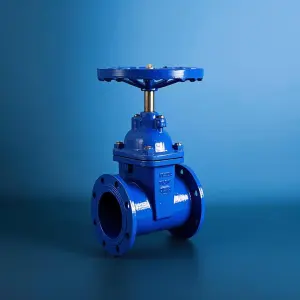
For water supply, wastewater, and industrial pipeline projects, selecting a suitable NRS Resilient Seated Gate Valve Supplier involves much more than finding a company that can provide an available valve. Pipeline systems often require large quantities of valves that must fit the same connection standards, provide consistent shutoff performance, and remain serviceable for many years. A supplier’s ability to maintain product consistency and support the project therefore becomes part of the overall reliability of the pipeline.
For this reason, evaluating valve supply should focus not only on whether a product meets a basic specification, but also on whether the complete supply process can support installation, commissioning, future maintenance, and later project expansion.
Understanding Application Requirements for NRS Resilient Seated Gate Valves
Different pipeline projects can use the same general valve type while operating under very different conditions. A valve used in an underground municipal distribution network may spend most of its service life fully open and only close during maintenance or emergency isolation. A valve installed in an industrial water system may face different operating frequencies, maintenance schedules, or surrounding equipment arrangements.
Important project conditions can include:
- Pipeline size and actual connection dimensions;
- Working and test pressure;
- Flange or connection standard;
- Installation orientation and available space;
- Water or wastewater service conditions;
- Expected operating frequency.
These factors need to be considered together rather than treated as separate product parameters. For example, matching DN alone does not guarantee that two components will connect correctly if they follow different flange drilling standards. Similarly, a valve may satisfy the pressure requirement but still create installation difficulties if its face-to-face dimensions or connection details do not match the existing pipeline.
A well-prepared project therefore confirms the actual connection and operating requirements before manufacturing begins. This reduces the need for field modification and helps ensure that the valve can be incorporated into the pipeline as originally intended.
Why Consistent Manufacturing Matters for Pipeline Projects
Large water infrastructure projects rarely require only one gate valve. A network may use dozens, hundreds, or even more valves across different branches, isolation zones, pumping stations, and treatment facilities. In such projects, consistency between production batches can be as important as the performance of an individual valve.
Stable production helps maintain:
- Consistent body and flange dimensions;
- Repeatable sealing performance;
- Similar operating characteristics;
- Compatible replacement products;
- More predictable installation conditions.
A single approved sample can demonstrate that a design is capable of meeting a requirement, but it does not automatically prove that later batches will behave in exactly the same way. For project supply, repeatability matters because dimensional variation or inconsistent assembly can create problems across multiple installation locations.
This becomes even more important when a project is completed in phases. Valves delivered months later may need to match equipment already installed during an earlier stage. Maintaining stable production specifications simplifies expansion work and makes future maintenance more manageable.
Quality Control Before Valve Delivery
Valve reliability depends on more than the appearance of the finished product. Manufacturing control throughout production affects whether the valve can achieve the intended sealing and operating performance after installation.
Quality procedures for gate valve production may include:
- Incoming material inspection;
- Dimensional verification after machining;
- Component and coating checks;
- Assembly inspection;
- Shell pressure testing;
- Seat sealing testing;
- Final visual and functional inspection.
Each stage addresses a different type of risk. Dimensional verification helps reduce installation mismatch, while assembly checks can identify component positioning problems before testing. Pressure and sealing tests provide evidence that the assembled valve can withstand the required conditions before it reaches the project site.
For international pipeline projects, this becomes especially important because a problem discovered after overseas shipment may involve more than replacing the valve itself. It can affect installation schedules, labor planning, crane availability, contractor coordination, and commissioning dates. Preventing problems before shipment is therefore often much more efficient than correcting them on site.
Technical Documentation Is Part of Project Compatibility
Valve projects depend on information as much as hardware. Engineering teams may need drawings, dimensional information, connection details, operating data, and testing documentation before installation can proceed.
If technical information is incomplete or confirmed too late, several project problems can arise. Flange interfaces may not match, installation space may be insufficient, accessories may be incorrectly prepared, or the valve may arrive before the surrounding pipeline is ready.
Technical communication before production can help confirm:
- Product configuration;
- Applicable connection standard;
- Required dimensions;
- Operating method;
- Project documentation;
- Inspection and delivery requirements.
This is especially relevant in international projects, where customers, contractors, designers, and suppliers may work with different standards and engineering conventions. Clear documentation reduces ambiguity and provides a common technical basis for production and installation.
Why Pressure Testing Should Be Considered as More Than a Final Check
Pressure testing is sometimes viewed as a simple pass-or-fail step at the end of production, but it also provides useful confirmation of assembly quality.
For an NRS Resilient Seated Gate Valve, shell and seat tests evaluate different aspects of the finished valve. The body must withstand pressure without unacceptable leakage or structural problems, while the seat must provide reliable isolation when the valve is closed.
Testing does not replace process control. A valve that passes a final test still depends on correct machining, component quality, coating condition, and assembly. However, combining controlled manufacturing with final performance verification provides a stronger quality framework than relying on visual inspection alone.
For bulk project orders, maintaining consistent testing procedures across batches is particularly valuable because it creates a repeatable standard for each delivery rather than evaluating products differently from one shipment to the next.
Technical Communication During International Valve Projects
International valve supply involves coordination between technical requirements, production scheduling, documentation, packaging, and delivery. Misunderstandings at the beginning of the project can become expensive once production is complete.
Typical points that may require confirmation include:
- Valve size and pressure requirement;
- Connection and flange standard;
- Face-to-face dimensions where relevant;
- Operating method;
- Application environment;
- Required documentation;
- Delivery schedule and packaging requirements.
The purpose of this communication is not to make the purchasing process more complicated. It is to resolve technical differences before they become installation problems.
A clear confirmation process can also be useful when one project contains several valve sizes or configurations. Instead of treating the order as a single undifferentiated batch, each requirement can be matched to the appropriate pipeline location.
Long-Term Supply Is Important for Infrastructure Projects
Water infrastructure is rarely completed once and never changed again. Distribution networks expand, treatment plants add capacity, damaged components require replacement, and existing systems are upgraded.
Future requirements may include:
- Additional valves for network expansion;
- Replacement valves during scheduled maintenance;
- Products for new pipeline phases;
- Repeat specifications for similar projects;
- Continued access to technical information.
Long-term supply capability can therefore reduce the need to repeatedly establish new product specifications or search for alternative components. Maintaining communication with the same supplier can also make it easier to reference earlier project requirements when preparing repeat orders.
This continuity is particularly useful when several project phases need to maintain the same general valve configuration.
RMT NRS Resilient Seated Gate Valve Supply Capability
RMT provides NRS Resilient Seated Gate Valve solutions for water supply, wastewater, and related pipeline applications. As a valve manufacturer and supplier, RMT supports project requirements from technical confirmation through manufacturing, inspection, and delivery coordination.
For project-based supply, RMT can work with customers to confirm application requirements and connection conditions before production. Manufacturing and inspection processes are used to support consistent product supply for both individual requirements and larger batch projects.
RMT’s support can include:
- Project and product requirement communication;
- Technical specification confirmation;
- Production arrangement for different project quantities;
- Quality inspection and testing;
- Documentation coordination;
- Delivery and repeat-order support.
For projects that continue through multiple construction phases, RMT can also support follow-up supply requirements, helping customers maintain greater consistency between initial deliveries, later expansion, and replacement needs.
FAQ
1. What are NRS Resilient Seated Gate Valves commonly used for?
They are commonly used for pipeline isolation in municipal water supply, wastewater treatment, water distribution, and industrial water systems where dependable shutoff is required.
2. Why is manufacturing consistency important for bulk gate valve projects?
Large projects use multiple valves across different locations. Consistent dimensions, sealing performance, assembly, and testing help reduce installation variation and simplify later replacement or expansion.
3. What information should be confirmed before valve production?
Typical information includes valve size, operating pressure, connection standard, installation environment, operating method, technical specifications, documentation requirements, and project delivery conditions.
4. Can an NRS Resilient Seated Gate Valve Supplier support repeat and expansion projects?
Yes. A supplier with stable manufacturing and project records can support initial orders, later project phases, maintenance replacements, and future expansion while helping maintain product consistency.
Conclusion
An NRS Resilient Seated Gate Valve Supplier contributes to more than the delivery of individual valves. For long-term water infrastructure projects, manufacturing consistency, technical confirmation, testing, documentation, and follow-up supply all influence how smoothly valves move from production to installation and eventually into long-term service.
RMT supports NRS Resilient Seated Gate Valve projects through manufacturing, quality control, technical coordination, and continued supply. By matching valve solutions to actual pipeline requirements and maintaining stable production across different project stages, RMT helps customers reduce installation uncertainty and build a more manageable long-term valve supply system.
Post time: Sep-03-2026