




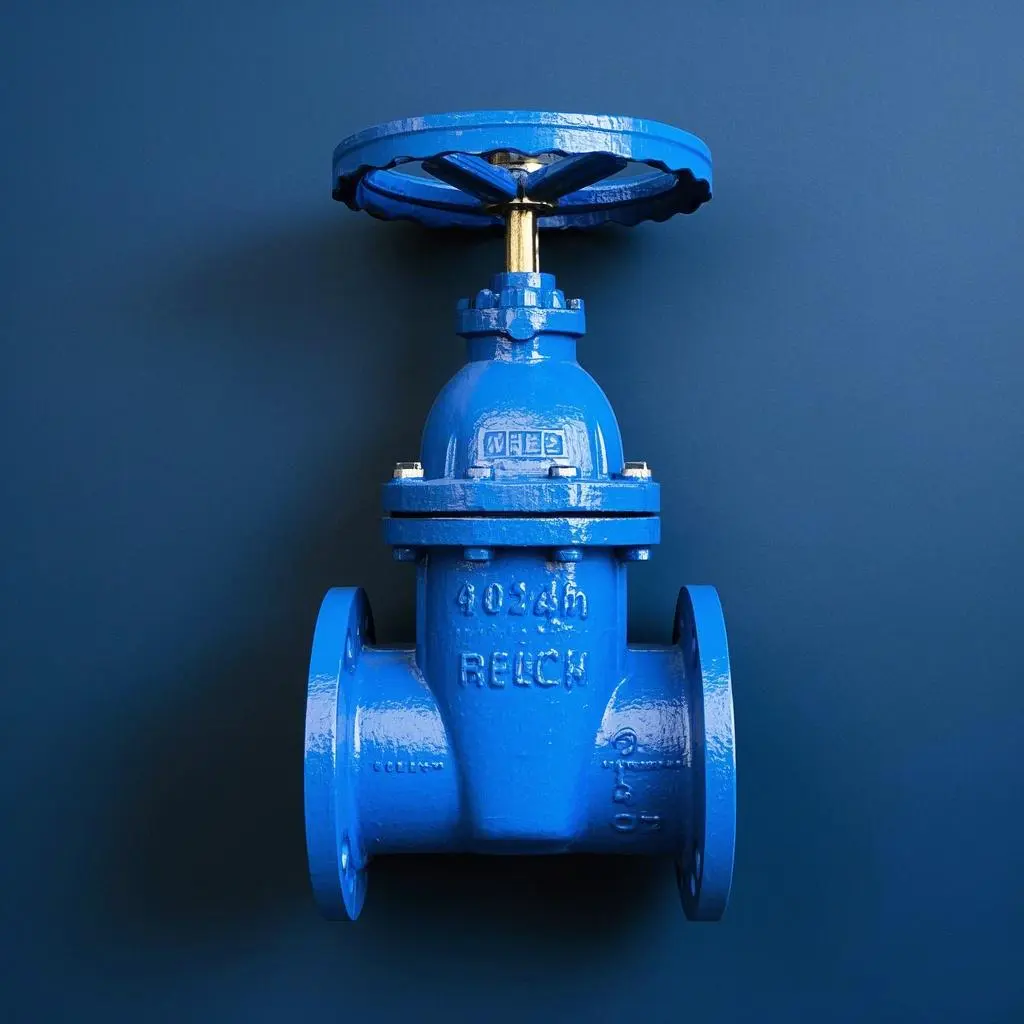
Selecting an NRS Resilient Seated Gate Valve involves more than checking nominal diameter and pressure rating. The dimensional series determines whether the valve fits an existing pipeline without additional modifications. DIN F4 and DIN F5 are common designs, but their differences are easy to overlook during replacement and project planning. Understanding these differences helps prevent installation problems, unnecessary pipeline adjustments, and delays.
The Main Dimensional Difference Between DIN F4 and DIN F5
DIN F4 and DIN F5 identify different face-to-face dimensions for resilient seated gate valves. Face-to-face length is the distance between the two end connection faces of a valve.
F4 generally represents a shorter pattern, while F5 represents a longer pattern. This affects the space required for installation and determines whether one design can replace another without changing the pipeline.
Neither designation indicates a different sealing principle. Both types of NRS gate valves can use an elastomeric resilient seat to provide shut-off when the gate closes. F4 and F5 describe the valve’s dimensional arrangement, not its sealing quality.
A longer body does not automatically mean better sealing, greater pressure resistance, or longer service life. These characteristics depend on the valve’s design, materials, manufacturing quality, and operating conditions.
When comparing NRS Resilient Seated Gate Valve options, treat face-to-face length as a separate specification alongside nominal diameter, pressure rating, and connection details.
Why Face-to-Face Length Matters During Replacement
In an existing pipeline, the available installation space is usually fixed. The distance between pipe sections, flanges, and nearby equipment may leave little room for dimensional changes.
Replacing an F4 valve with an F5 design may create a fit problem because the longer body can exceed the available space. The pipework may need to be repositioned or modified, adding time and cost to the replacement.
The reverse situation also needs attention. Installing a shorter F4 valve where an F5 design was specified may leave a gap between connection points. Forcing the pipeline connections into position is not a reliable solution because mechanical stress can affect flange alignment and connection integrity.
Before ordering a replacement NRS gate valve, measure the existing valve’s face-to-face length and compare it with the proposed replacement’s dimensional drawing. Do not estimate the length from nominal diameter alone.
This is especially important when replacing older equipment. Nameplates may be unreadable and installation records incomplete. In these cases, actual measurements, flange details, and available space provide a more reliable basis for selecting a compatible resilient seated gate valve.
Choosing F4 or F5 for a New Pipeline
For a new pipeline, begin with the approved engineering design rather than a general preference for a shorter or longer valve.
If the drawings specify F4, using the same dimensional series helps maintain the intended installation arrangement. The same applies to F5. Changing the series without reviewing the pipeline layout may create connection problems, even when nominal diameter and pressure rating appear suitable.
Available space is another consideration. A compact equipment room or a pipeline with closely positioned components may restrict the valve’s overall length. However, choosing F4 simply to save space is not appropriate if the project requires F5.
Also consider access after installation. There must be sufficient room to operate the handwheel, operating nut, or other mechanism and to carry out inspection and maintenance. Space around the NRS Resilient Seated Gate Valve should therefore include both the body dimensions and the operating area.
The appropriate design is the one that meets the specified dimensions and operating requirements, not necessarily the shortest available option.
Specifications to Check Alongside the Dimensional Series
Face-to-face length is only one part of NRS gate valve selection. A valve may match the required length but still be unsuitable if its connections or operating specifications do not meet pipeline conditions.
Nominal diameter and pressure rating
The nominal diameter must correspond to the pipeline connection size. Select the pressure rating according to the system’s design pressure and operating conditions. An F4 or F5 designation alone does not confirm pressure suitability.
Flange drilling and connection standard
Check the flange dimensions and drilling pattern against the connecting pipeline components. Differences in bolt-hole arrangement or flange standards can prevent installation even when the face-to-face length is correct.
Operating medium and temperature
Evaluate whether the resilient seat and other wetted materials are compatible with the conveyed medium. Water quality, temperature, and chemical characteristics may influence material selection and service life. A resilient seated gate valve should be specified for the actual operating environment.
Installation and operation
Consider installation orientation, available operating space, accessibility, and expected operating frequency. These factors help determine whether the selected gate valve can be operated and maintained effectively.
Reviewing these requirements together reduces the risk of choosing a valve that matches one dimension but fails to meet the application’s overall needs.
Common Selection Mistakes
Many replacement problems result from incomplete specification checks rather than defects in the valve.
One frequent mistake is assuming that valves with the same nominal diameter are interchangeable. Nominal diameter identifies the general connection size; it does not define face-to-face length or flange configuration. Two NRS Resilient Seated Gate Valve models with the same DN designation may have different external dimensions.
Another mistake is relying on an old purchase description without checking the installed valve. Previous modifications may have changed the original arrangement, or project records may not reflect the current pipeline.
It is also risky to treat F4 and F5 as interchangeable because their sealing structures are similar. Similar sealing principles do not mean identical external dimensions. Confirm the dimensional series before ordering a replacement gate valve.
Before selecting a replacement, verify:
-
Existing face-to-face length and required dimensional series.
-
Nominal diameter and pipeline pressure requirements.
-
Flange standard, drilling pattern, and connection dimensions.
-
Operating medium and temperature range.
-
Available installation space and operating access.
-
Relevant drawings, photographs, and project specifications.
If the existing designation is unclear, provide measured dimensions and connection details rather than relying on the product name alone.
Preparing Information Before Requesting a Quotation
Complete specifications reduce repeated confirmation and the risk of receiving a valve that cannot fit the pipeline. For replacement projects, start with the existing valve’s dimensional information. A readable nameplate may help identify nominal diameter, pressure rating, and dimensional series, but these details should still be checked against actual measurements.
For a new installation, use approved pipeline drawings to confirm face-to-face length and flange arrangement. State any special material, coating, or testing requirements before requesting a quotation. Clear information allows the proposed NRS Resilient Seated Gate Valve to be assessed against actual installation conditions instead of assumptions based on a few basic parameters.
For projects requiring an NRS Resilient Seated Gate Valve, RMT Flowtech offers DIN F4 and DIN F5 configurations. Its listed F4 range covers DN50–DN600 with PN10 and PN16 options, while its F5 range covers DN50–DN600 with PN16 options. The listed operating medium is water, with a temperature range of 0–80°C. Confirm the required size, pressure rating, face-to-face dimensions, flange details, and application conditions with the manufacturer before ordering.
Conclusion
DIN F4 and DIN F5 mainly differ in face-to-face dimensions. Although both designs can use the same resilient seated sealing principle, their different lengths affect pipeline compatibility and replacement arrangements.
Choose the dimensional series based on measured dimensions, approved drawings, connection standards, pressure requirements, and installation conditions. Verifying these details before ordering helps reduce modification work and supports a reliable installation.
FAQs
1. Is a DIN F4 NRS Resilient Seated Gate Valve shorter than an F5 valve?
Generally, yes. F4 is the shorter dimensional series, while F5 has a longer face-to-face dimension. The exact length depends on nominal size and the applicable dimensional standard.
2. Can a DIN F5 valve directly replace an F4 valve?
Not necessarily. The longer face-to-face dimension may exceed the available installation space. Compare the existing valve dimensions with the replacement drawing before ordering.
3. Do DIN F4 and F5 valves have different sealing principles?
No. F4 and F5 identify dimensional series, not different sealing principles. Both designs can use a resilient seated gate structure.
4. What information is needed when ordering an F4 or F5 valve?
Provide the dimensional series, nominal diameter, pressure rating, flange standard, operating medium, temperature, and any project-specific material or testing requirements.
Post time: Nov-24-2026