




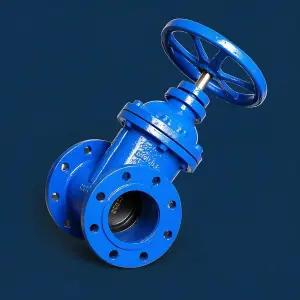
An NRS Resilient Seated Gate Valve is widely used in municipal water supply, distribution networks, water treatment plants, pumping stations, and industrial water pipelines where reliable isolation is required. Its two defining features are the Non-Rising Stem (NRS) design and the Resilient Seated sealing structure. While the NRS configuration helps reduce the vertical space required for valve operation, the resilient seat plays a more direct role in establishing shutoff when the gate reaches the closed position.
For water pipeline systems, the purpose of a gate valve is not simply to stop flow. The valve may remain fully open for months or years and then suddenly be required to isolate a section of pipeline for maintenance, equipment replacement, leakage repair, or emergency work. This means long-term operability and reliable sealing are both important. A suitable NRS Resilient Seated Gate Valve therefore needs to be considered as part of the entire pipeline system rather than as an isolated mechanical component.
How Does an NRS Resilient Seated Gate Valve Work?
During operation, the stem rotates through the valve’s operating mechanism and moves the gate between the open and closed positions. In an NRS configuration, the stem does not rise vertically above the valve body as the gate moves. This makes the design particularly useful where the installation area has limited vertical clearance, such as underground valve chambers and buried water distribution systems.
When the valve is fully open, the gate is lifted away from the main flow passage, allowing water to move through the valve with relatively little obstruction. As the valve closes, the gate moves into the sealing area. The resilient material surrounding the gate or incorporated into the sealing structure deforms against the corresponding sealing surfaces and creates the contact needed for shutoff.
The important point is that valve isolation depends on the complete closing process. Stem movement must be transmitted correctly to the gate, the gate must reach its intended position, and the sealing surfaces must establish proper contact. A resilient seat can accommodate certain minor surface irregularities, but it cannot compensate indefinitely for incorrect installation, damaged components, excessive debris, or incomplete gate travel.
Why Is Resilient Seating Important in Water Applications?
Water pipeline isolation often requires low leakage and dependable shutoff rather than fine flow adjustment. Resilient seating is well suited to this operating requirement because the elastic sealing material can deform under appropriate closing conditions and maintain contact with the sealing surfaces.
Compared with a metal-seated design, a resilient seat is generally less dependent on extremely precise metal-to-metal contact. This can be useful in water systems where the valve may experience long service periods, repeated operation, or minor changes in sealing-surface condition.
However, resilient seating should not be treated as a guarantee of perfect sealing under every condition. Its performance still depends on the condition of the sealing material, gate alignment, cleanliness of the sealing area, operating procedure, and characteristics of the water or other medium. Large particles, sediment, corrosion products, or mechanical damage can interfere with the sealing interface and prevent the valve from achieving its intended shutoff performance.
The practical advantage of resilient seating is therefore better contact adaptability within its designed operating conditions, rather than simply the fact that the material is softer than metal.
Why Is an NRS Design Useful for Underground Water Pipelines?
One of the main advantages of an NRS Gate Valve is its compact vertical operating arrangement. Because the stem does not rise substantially as the valve opens, the valve can be installed in locations where vertical space is restricted.
This is particularly relevant to underground water networks. Valve chambers, buried pipelines, and urban utility corridors often have limited space because multiple pipelines, electrical systems, drainage facilities, and other infrastructure may occupy the same area. A rising-stem valve can require additional clearance above the valve, while an NRS configuration can simplify the space arrangement.
At the same time, the absence of a visibly rising stem means that operators cannot determine the gate position simply by looking at the stem height. The valve therefore needs a suitable operating indicator, position marking, or other method to confirm its status where required.
For buried applications, protection of the operating components is also important. Stem corrosion, improper extension arrangements, damaged operating accessories, and accumulated contamination can affect the ability to operate the valve after long periods of inactivity.
Why Should Gate Valves Normally Be Fully Open or Fully Closed?
A gate valve is primarily an isolation valve, not a continuous flow-control device. When fully open, the gate is removed from most of the flow path. When fully closed, it provides the required pipeline isolation.
Using a gate valve continuously in a partially open position can create unfavorable hydraulic conditions. The reduced opening concentrates the flow through a smaller passage, potentially increasing local velocity and turbulence. Depending on the pressure differential and flow conditions, prolonged throttling may also contribute to vibration, erosion, or uneven loading around the gate and sealing areas.
For this reason, an NRS Resilient Seated Gate Valve is generally better operated as:
Fully Open for Normal Flow → Fully Closed for Isolation
If a pipeline requires frequent and precise flow regulation, a valve type specifically designed for throttling should normally be considered instead of relying on a gate valve for continuous adjustment.
Does Higher Closing Torque Mean Better Sealing?
Not necessarily. This is an important distinction in gate valve operation.
The valve needs sufficient operating torque to overcome friction, hydraulic forces, and the resistance of the sealing system so that the gate can reach its intended position. Once the gate has properly reached the closed position and the resilient seat has established the required contact, applying excessive force does not automatically produce better sealing.
Excessive torque can instead place unnecessary stress on the stem, operating mechanism, gate connection, and sealing components. It may also make future operation more difficult if the valve remains unused for a long period.
A more useful operating principle is to focus on complete gate travel and correct final positioning, rather than simply maximizing the force applied to the handwheel, gearbox, or actuator.
Where automated or powered operation is used, the actuator or gearbox should therefore be matched to the valve’s actual operating requirements rather than selected solely on the assumption that more torque provides better isolation.
What Factors Can Affect Long-Term Sealing Performance?
Initial pressure testing can confirm that a newly installed valve meets the required test conditions, but long-term reliability involves more than the initial test result. Water valves are often expected to remain in service for many years, and some isolation valves may be operated only a few times during their service life.
Several factors can influence their long-term performance.
Gate movement: Internal components must remain capable of moving the gate through its complete stroke. Corrosion, contamination, damaged threads, or problems with the operating mechanism can make an otherwise functional valve difficult to close.
Sealing material: The resilient seat needs to remain in suitable condition for the intended service environment. Temperature, medium characteristics, aging, mechanical damage, and unsuitable operating conditions can affect its performance.
Pipeline cleanliness: Sediment and foreign particles can become trapped in the sealing area. Although resilient seating can tolerate minor surface variations, it cannot compensate for significant debris accumulation or damaged sealing surfaces.
Pressure conditions: Differential pressure can influence the force required to operate the valve. Operating procedures should therefore consider actual pipeline pressure rather than assuming that every closing operation will require the same amount of torque.
Installation and maintenance: Incorrect installation, unsuitable operating accessories, poor protection of buried components, or lack of periodic inspection can all affect long-term availability.
These factors demonstrate why valve reliability should be evaluated as a combination of mechanical operation and sealing performance.
Resilient Seated vs. Metal Seated Gate Valve: What Is the Difference?
The difference between resilient and metal seating is mainly the way the sealing interface is established.
| Feature | Resilient Seated Gate Valve | Metal Seated Gate Valve |
|---|---|---|
| Sealing principle | Elastic material creates sealing contact | Metal sealing surfaces establish contact |
| Contact adaptability | Can accommodate certain minor surface variations | More dependent on sealing-surface condition |
| Typical water application | Commonly used for water pipeline isolation | Selected according to specific medium and service conditions |
| Key concerns | Seat condition, debris, aging, operating condition | Surface wear, contact condition, corrosion and compatibility |
| Main function | Pipeline isolation | Pipeline isolation, depending on design and application |
Neither design should be considered universally superior. The appropriate choice depends on the medium, pressure, temperature, pipeline environment, maintenance requirements, and applicable standards.
For many conventional water distribution and treatment applications, resilient seating provides a practical combination of reliable shutoff and contact adaptability. For other media or harsher service conditions, a different sealing configuration may be more appropriate.
What Should Be Considered When Selecting an NRS Resilient Seated Gate Valve?
Valve selection should go beyond nominal diameter and pressure rating. The actual pipeline conditions determine whether the valve can operate reliably throughout its service life.
Important considerations include the pipe size, pressure conditions, connection standard, installation location, medium characteristics, operating frequency, available operating space, and required method of operation. Underground installations may require particular attention to stem protection and operating extensions, while above-ground applications may place greater emphasis on accessibility and visual position indication.
The expected frequency of operation is also important. A valve that will remain fully open for years requires a different maintenance and reliability focus from a valve that will be operated regularly. In both cases, the valve should be capable of reaching the required position without excessive operating force.
The overall pipeline design should also consider whether the valve is being used strictly for isolation or is expected to perform additional functions. Keeping the valve’s intended role clear helps avoid operating conditions that fall outside the characteristics of a gate valve.
What NRS Gate Valve Solutions Can RMT Provide?
For municipal water supply, water distribution, water treatment, pumping stations, and other pipeline systems requiring dependable isolation, RMT can provide NRS Resilient Seated Gate Valve solutions based on the actual application requirements.
Rather than considering only valve size and pressure rating, the selection can take into account pipeline conditions, connection requirements, installation environment, operating method, water characteristics, and space limitations. For underground systems, the NRS structure can be considered together with the available operating space and valve accessibility. For pipelines with long periods of fully open operation, long-term operability and reliable closure should also be part of the evaluation.
This application-based approach helps ensure that the valve design corresponds to the actual isolation requirements of the water pipeline.
FAQ
1. What is an NRS Resilient Seated Gate Valve?
An NRS Resilient Seated Gate Valve is a gate valve that combines a Non-Rising Stem operating design with a resilient sealing structure. It is widely used for isolating water pipelines in municipal, industrial, and water treatment systems.
2. Why are resilient seats commonly used in water gate valves?
A resilient seat can deform within its designed range to establish continuous contact with the sealing surfaces. This provides useful contact adaptability for many conventional water isolation applications.
3. Can an NRS Resilient Seated Gate Valve be used for flow regulation?
It is primarily designed for full-open or full-closed isolation. Continuous throttling with a partially open gate can create unfavorable flow conditions, so a valve specifically designed for flow regulation is generally more appropriate when precise control is required.
4. What affects the long-term performance of an NRS Gate Valve?
Long-term performance can be affected by gate movement, resilient seat condition, water quality, debris, pressure differential, corrosion, installation quality, operating frequency, and maintenance practices. Reliable isolation depends on the combined condition of these factors.
Conclusion
An NRS Resilient Seated Gate Valve is more than a combination of a non-rising stem and resilient sealing material. Its value comes from how these design features work together within a complete pipeline isolation system. The NRS configuration can be advantageous where vertical installation space is limited, while the resilient seat provides an adaptable sealing interface for many conventional water applications.
However, reliable isolation cannot be determined by the sealing material alone. Gate travel, operating torque, pressure conditions, water quality, debris, installation, and long-term maintenance can all influence whether the valve performs as expected when isolation is eventually required.
For this reason, the most useful way to evaluate an NRS Resilient Seated Gate Valve is not simply to ask whether it can close, but whether it can operate correctly, reach the intended position, establish reliable sealing contact, and remain ready for isolation after long-term service. That is what makes resilient seated NRS gate valves particularly relevant to water supply, distribution, pumping, and water treatment pipeline systems.
Post time: Aug-21-2026