




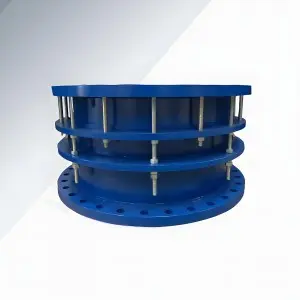
A Pipe Joint is a mechanical fitting used to connect two pipe sections without relying on field welding or threaded assembly. It typically uses a body, sealing gaskets, end rings, and tightening bolts to create a pressure-resistant connection around the outside surface of the pipe.
As the bolts are tightened, the end rings compress the gaskets between the fitting body and the pipe wall. The gasket deforms around the pipe circumference, sealing the connection and helping stabilize the two pipe ends. This structure is widely used in municipal water supply, drainage systems, pumping stations, industrial water pipelines, irrigation networks, and pipeline renovation projects.
The practical value of a Pipe Joint is not limited to joining two pipes. It can simplify installation, reduce the amount of pipe-end processing, accommodate limited outside-diameter variation, and provide a removable connection for future maintenance or system modification.
The Most Difficult Part of a Pipeline Is Often the Connection Point
A straight pipe section is generally predictable. Its material, outside diameter, pressure rating, and installation direction are clearly defined. Problems often begin where two pipe sections meet.
At a connection point, several conditions must be controlled at the same time:
- The two pipe ends must remain reasonably aligned;
- The connection must withstand internal pressure;
- The sealing surface must remain stable during pressure changes;
- Pipe outside-diameter tolerances must be accommodated;
- External loads should not distort the joint;
- The connection should remain accessible for future inspection.
If any of these conditions are ignored, the joint may become the weakest part of the pipeline.
Common symptoms of an unsuitable connection include leakage after pressure testing, gasket displacement, uneven bolt loading, pipe-end movement, local corrosion, and repeated maintenance at the same position.
A mechanical Pipe Joint addresses these risks by creating a controlled sealing and clamping zone around both pipe ends.
How the Joint Forms a Seal Around the Pipe
Unlike a flanged connection, which seals between two flat flange faces, a Pipe Joint seals against the outside surfaces of the pipes.
The connection process usually follows four stages:
- The joint body and end rings are positioned around the pipe ends.
- Each pipe is inserted to the required depth.
- The bolts are tightened gradually and evenly.
- The gaskets are compressed against the pipe surfaces to form the seal.
The sealing force is distributed around the circumference of the pipe. This helps accommodate limited variation in outside diameter and small surface irregularities.
A reliable connection depends on balanced gasket compression. Tightening one side excessively before the opposite side can create uneven sealing pressure, distort the end ring, and shift the pipe position.
For this reason, bolts should be tightened progressively in a cross pattern rather than fully tightening them one at a time.
Why Mechanical Joints Are Useful During Pipeline Construction
Pipeline projects do not always take place under ideal workshop conditions. Pipe ends may be installed underground, inside valve chambers, near existing structures, or in areas where welding equipment is difficult to use.
A mechanical Pipe Joint can simplify these situations because it generally requires less pipe-end preparation than welded or specially fabricated connections.
It can be useful where:
- Welding is restricted or inconvenient;
- Existing pipe sections need to be extended;
- Damaged sections have been removed and replaced;
- A new branch or equipment section is added;
- Pipe materials have suitable outside diameters but different connection methods;
- The pipeline may need to be dismantled again in the future.
This does not mean the joint can compensate for severe installation errors. The pipe ends still need to be properly prepared, supported, and aligned. Its advantage is that it creates a practical connection without requiring every pipe end to be machined or welded into a permanent assembly.
Old Pipeline Repair Requires a Different Connection Strategy
Existing water networks often contain pipes that have been operating for many years. Their surfaces may be corroded, coated, slightly deformed, or dimensionally different from newly supplied pipe.
When a damaged section is removed, the replacement pipe must connect to the existing system without creating excessive stress.
In this situation, a Pipe Joint can provide several practical advantages:
- Reduced need for welding near an operating network;
- Faster connection of replacement pipe sections;
- Accommodation of limited outside-diameter variation;
- Easier adjustment of insertion position;
- A removable interface for later maintenance;
- Reduced disturbance to adjacent pipeline sections.
The sealing area on the existing pipe must still be structurally sound. Heavy pitting, deep longitudinal grooves, severe wall loss, or loose coating may prevent the gasket from forming a stable seal.
The joint cannot restore the mechanical strength of a badly deteriorated pipe. Damaged material must first be removed or repaired until a suitable connection surface is available.
Gasket Condition Determines Long-Term Sealing
The gasket is the main sealing component inside the Pipe Joint. It must remain flexible enough to conform to the pipe surface while maintaining compression during pressure and temperature changes.
Its long-term performance depends on:
- Medium composition;
- Operating temperature;
- Water quality;
- Compression level;
- Aging resistance;
- Surface condition of the pipe;
- Exposure to chemicals or oils;
- Frequency of pressure cycling.
For standard water service, elastomeric gaskets are commonly used. In wastewater or industrial applications, the gasket material should be compatible with the actual medium.
Excessive compression does not always improve sealing. Over-tightening can deform the gasket, damage the pipe coating, or distort the joint components. Proper sealing comes from uniform compression within the intended working range.
Surface Preparation Is Part of the Joint
Even a well-designed fitting cannot seal reliably against an unsuitable pipe surface.
Before installation, the pipe ends should be checked for:
- Mud, sand, grease, and loose debris;
- Rust scale;
- Sharp edges;
- Deep scratches;
- Damaged coating;
- Excessive ovality;
- Severe corrosion pits.
The sealing area should be cleaned without unnecessarily damaging the pipe wall or protective coating. Sharp burrs should be removed because they may cut or displace the gasket during insertion.
The pipe should also be marked to show the required insertion depth. This helps confirm that both pipe ends are properly positioned before bolt tightening begins.
Typical Uses Across Water Infrastructure
Pipe Joints are used throughout water and utility networks where secure, maintainable pipe connections are required.
Municipal Water Distribution
They can connect new pipe sections, replace damaged lengths, and support network extension or valve chamber modification.
Drainage and Wastewater Pipelines
Mechanical joints provide accessible connections in pumping stations, treatment facilities, and pressurized drainage networks.
Pumping Stations
They may be used between pipe sections or around valves and related fittings, provided that axial thrust and equipment loads are controlled separately.
Industrial Water Systems
Cooling water, process water, and circulating water pipelines often require removable mechanical connections for system modification and maintenance.
Irrigation Networks
They simplify the connection of field pipelines, pumping lines, and control stations, particularly where installation conditions vary across the site.
RMT Pipe Joint for Water Pipeline Connections
RMT provides valves and pipe fittings for municipal water supply, drainage, wastewater treatment, pumping stations, irrigation, and industrial water systems.
The RMT Pipe Joint can be adapted to different pipe outside diameters, nominal sizes, pressure ratings, gasket materials, bolt arrangements, and coating requirements. Its mechanical structure supports pipeline extension, repair, replacement, and connection work without requiring a permanent welded interface.
Stable performance depends on the complete installation condition. Pipe diameter, surface quality, insertion depth, bolt tightening, pressure load, alignment, support, and axial restraint all influence the final result.
FAQ
1. What Is a Pipe Joint Used For?
It is used to connect two pipe sections mechanically, supporting pipeline construction, extension, repair, and replacement.
2. Can a Pipe Joint Connect Pipes with Different Outside Diameters?
Some joint designs provide a defined diameter range, but the actual outside diameters must remain within the fitting’s sealing capacity.
3. Does a Pipe Joint Prevent Pipe Pull-Out?
Not every design provides full axial restraint. Where pressure thrust or movement is significant, restrained structures, anchors, or thrust blocks may be required.
4. What Causes Leakage at a Mechanical Pipe Joint?
Common causes include incorrect pipe diameter, damaged pipe surfaces, poor alignment, insufficient insertion, uneven bolt tightening, gasket incompatibility, and excessive pipeline movement.
Conclusion
A Pipe Joint provides a practical mechanical connection for water, drainage, irrigation, and industrial pipelines. By compressing sealing gaskets around the outside surfaces of two pipe sections, it creates a removable and maintainable interface without depending on field welding.
Its reliability depends on more than the fitting itself. Accurate pipe dimensions, clean sealing surfaces, correct insertion depth, balanced bolt tightening, proper support, and control of axial forces are all essential.
When these conditions are properly managed, a Pipe Joint can simplify pipeline construction, repair, extension, and equipment modification while maintaining stable pressure sealing over long-term operation.
Post time: Aug-06-2026