




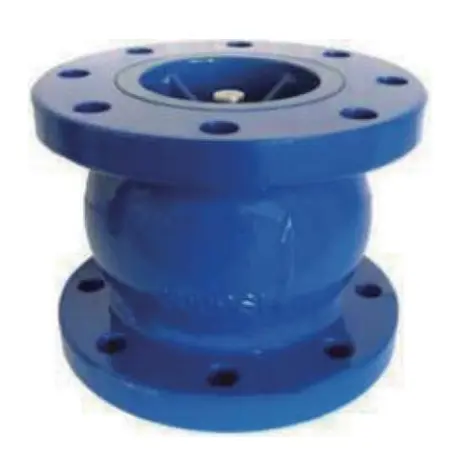
A Silent Check Valve is commonly used where reverse flow needs to be stopped without creating the sharp impact associated with conventional check valves. In water-supply systems, pump stations, and long pipelines, this difference can become important because a check valve does not operate in isolation. Its closing behavior is closely connected to the velocity of the water column, pump operation, pipeline length, and pressure changes throughout the system.
A valve may therefore have no visible leakage and still create an operational problem. If the disc closes too late, reverse flow may develop before the valve reaches the closed position. If it closes too abruptly, the resulting pressure change can travel through the pipeline and affect nearby equipment. For this reason, evaluating a Silent Check Valve should involve more than checking whether it stops reverse flow.
Silent Check Valve Closing Behavior and Pipeline Pressure
The key difference between a Silent Check Valve and a conventional check valve is not simply the amount of noise produced during operation. The more important issue is how the valve responds when forward flow begins to decrease and the system approaches a flow reversal.
When the closing element remains open for too long, reverse flow can begin before the valve has fully closed. The resulting movement forces the disc toward the seat under less favorable conditions, potentially increasing mechanical impact and pressure fluctuation.
A Silent Check Valve is designed to respond to this change in flow with a controlled closing action. The purpose is not simply to make the valve close as quickly as possible, but to reduce the opportunity for significant reverse velocity to develop before closure.
Why Pump Stations Are Sensitive to Check Valve Behavior
Check valves installed near pumps experience operating conditions that are different from those in a simple gravity pipeline. When a pump starts or stops, the flow velocity can change rapidly, and the check valve becomes part of that transition.
If the valve remains open for too long after pump shutdown, reverse flow can move back toward the pump. That may increase mechanical stress and create undesirable pressure changes in the discharge line. On the other hand, an excessively abrupt closure can produce its own transient problem.
The correct valve therefore needs to match the pump and pipeline rather than being selected only according to nominal pipe diameter. Pump capacity, discharge arrangement, expected operating cycles, pipeline length, and the position of the check valve can all influence the final result.
For critical pump stations, understanding the relationship between pump shutdown and check-valve closure can be more useful than simply choosing a valve with a higher pressure rating.
Why a Silent Check Valve Is Not Just a “Quieter” Check Valve
The name Silent Check Valve can easily lead to the assumption that the main purpose is noise reduction. Noise is certainly relevant, but the underlying issue is the valve’s hydraulic closing behavior.
A conventional check valve may allow the disc to travel significantly before reaching the final closed position. When reverse flow has already developed, the disc can return against the seat with greater impact. That impact may generate both audible noise and mechanical vibration.
A Silent Check Valve aims to reduce this effect by using a design that allows the closing element to respond with less travel and less opportunity for substantial reverse flow to develop.
As a result, the value of the design is not limited to making the pipeline quieter. More controlled closure can also help reduce mechanical shock around the valve and provide more stable operating conditions for connected equipment.
Where Does Installation Position Become Important?
The position of a Silent Check Valve within the pipeline can influence how it responds to changing flow conditions. A valve installed immediately downstream of a pump may experience a different flow profile from one installed farther away after several changes in pipe direction or diameter.
Nearby elbows, reducers, expansion sections, and other fittings can disturb the flow entering the valve. If the flow approaching the disc is uneven, the closing element may not behave as intended even when the valve itself is correctly manufactured.
This does not mean every check valve requires a large amount of straight pipe. The important point is that installation conditions should be considered together with the valve design. When a project involves a compact pump station or restricted installation space, the manufacturer should know the actual arrangement before confirming the final configuration.
Why Oversizing a Silent Check Valve Can Create Another Problem
It may seem safer to select a larger check valve because a larger passage appears to offer lower resistance. However, valve size should correspond to the actual pipeline and operating conditions rather than being increased without a clear reason.
If the operating flow is too low for the selected valve, the closing element may not remain in a stable operating position. Depending on the design, repeated movement can contribute to vibration, unstable operation, or unnecessary wear.
The opposite problem can occur when a valve is too small for the required flow. Higher velocity through the valve can increase pressure loss and operating stress.
Therefore, Silent Check Valve selection should consider the normal operating flow as well as the pipe’s nominal diameter. A correct match is more useful than simply selecting the largest available size.
Why Pump Shutdown Conditions Should Be Included in Valve Selection
Many valve specifications focus heavily on normal operating pressure, but check-valve performance is particularly relevant during abnormal or transitional conditions.
For a pump discharge system, the engineering team should understand what happens when the pump stops unexpectedly, when power is interrupted, or when another pump in a parallel arrangement starts or stops. These events can produce flow changes that are very different from normal steady operation.
A Silent Check Valve should therefore be considered as part of the complete pump-pipeline system. If the system has frequent starts and stops, multiple pumps, long discharge pipelines, or significant elevation changes, the closing characteristics deserve particular attention.
This approach can also help explain why the same check valve may perform well in one installation but require a different configuration in another.
RMT Silent Check Valve for Water Pipeline Applications
RMT provides check-valve solutions for water-supply and drainage applications, with product configurations selected according to pipeline size, pressure requirements, connection conditions, and operating environment.
For a Silent Check Valve project, RMT can review the basic pipeline information before production, including DN, working pressure, medium, normal flow condition, pump arrangement, installation position, connection standard, and required quantity. For pump-station projects, providing information about pump start/stop conditions and the pipeline layout can also help the technical team understand the actual operating environment.
This project information is particularly useful when the purpose of the check valve is not simply to prevent reverse flow, but also to control the way the pipeline responds during pump shutdown and other transient conditions.
Conclusion
A Silent Check Valve should not be evaluated only by whether it prevents reverse flow. Its closing behavior can influence pressure changes, vibration, noise, and the operating conditions of pumps and pipelines.
For water-supply and pump-station projects, matching the valve to the actual flow conditions and installation arrangement can be more important than simply selecting a valve based on nominal size or pressure rating. RMT can review these project conditions before production to help confirm a Silent Check Valve configuration suited to the complete pipeline system.
FAQ
1. Is a Silent Check Valve only used to reduce noise?
No. Its closing behavior is also important because it can help reduce the reverse-flow development and mechanical impact associated with abrupt check-valve closure.
2. Can a Silent Check Valve be used near a pump?
Yes. Pump discharge lines are one of the applications where controlled check-valve closing can be particularly important. The valve should be selected according to the pump and pipeline operating conditions.
3. Does a larger Silent Check Valve always perform better?
No. Valve size should match the actual pipeline and operating flow. An oversized valve can operate outside its intended flow range, while an undersized valve can create unnecessary pressure loss.
4. What information is useful when selecting a Silent Check Valve?
DN, working pressure, medium, flow conditions, pump arrangement, installation position, connection standard, and quantity are useful starting points. For pump stations, pump start/stop conditions and pipeline layout can provide additional information.
Post time: Sep-24-2026