




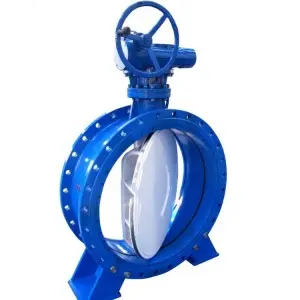
A Triple Eccentric Butterfly Valve, also called a triple offset butterfly valve, is designed to reduce one of the main wear mechanisms found in conventional butterfly valves: repeated rubbing between the disc and seat during opening and closing.
Its value does not come simply from having “three offsets.” The three offsets change how the disc moves toward and away from the seat, allowing most of the rotation to occur with little or no sliding contact at the primary sealing surfaces. This makes the structure particularly useful when metal sealing, higher temperature capability, frequent cycling, or demanding differential-pressure conditions are required.
The Three Offsets at a Glance
The function of the three offsets can be summarized simply:
- First offset: moves the shaft away from the seat sealing plane.
- Second offset: moves the shaft away from the valve bore centerline.
- Third offset: changes the angle of the sealing geometry so that significant seat contact occurs mainly near final closure.
The first two offsets create a cam-like disc movement. The third changes the final sealing contact.
Together, they reduce continuous disc-to-seat rubbing and allow sealing force to be developed mainly as the valve reaches the closed position.
What Does Each Offset Actually Change?
First Offset: Shaft Position Relative to the Seat
In a concentric butterfly valve, the shaft is positioned close to the central sealing plane. This means the disc and seat remain in contact through much of the rotational movement.
The first eccentricity moves the shaft away from this sealing plane. This begins to reduce interference between the rotating disc and the seat.
Second Offset: Shaft Position Relative to the Pipeline Centerline
The second offset moves the shaft away from the centerline of the valve bore.
Combined with the first offset, this creates an eccentric rotation. Once the disc begins opening, it quickly moves away from the seat rather than continuing to slide against it.
This is one of the main reasons double eccentric butterfly valves already show significantly lower seat rubbing than concentric designs.
Third Offset: Sealing Surface Angle
The third offset is different because it is not simply another shaft displacement.
It comes from the angular geometry of the seat and sealing ring. The sealing surfaces are arranged so that they approach each other progressively near the final closed position.
This changes the contact from continuous sliding toward controlled final seating.
In practical terms: the first two offsets help the disc leave the seat quickly; the third offset controls how it returns to the seat.
That distinction explains much of the performance difference between double and triple eccentric butterfly valves.
Concentric vs Double Eccentric vs Triple Eccentric Butterfly Valve
The three structures are easier to compare by looking at how the sealing surfaces behave.
| Valve Type | Seat Contact During Rotation | Common Seat Type | Main Strength | Typical Use |
|---|---|---|---|---|
| Concentric | Relatively high | Resilient | Simple structure and reliable water isolation | General water, HVAC, utility systems |
| Double Eccentric | Reduced after opening begins | Resilient or high-performance seat | Lower rubbing and operating torque | Large water pipelines, frequent operation |
| Triple Eccentric | Contact concentrated near final closure | Commonly metal seated | Non-rubbing sealing motion and controlled torque seating | Higher temperature, pressure, cycling, demanding isolation |
This comparison also shows an important point:
Triple eccentric does not automatically mean better for every pipeline.
For ordinary clean-water service at moderate pressure and temperature, a resilient seated or double eccentric butterfly valve may already provide the required performance with a simpler structure.
Triple offset geometry becomes more valuable when the operating conditions actually require its sealing characteristics.
Why Reduced Seat Rubbing Matters
Seat condition has a direct effect on butterfly valve shutoff performance.
In a valve where the disc repeatedly slides against the seat, every operating cycle creates friction. Over time, this can change the sealing surface, especially when the valve operates frequently.
The effect becomes more important when:
- Valve cycling frequency is high;
- Differential pressure is significant;
- Seat materials are relatively hard;
- Operating temperature is elevated;
- Tight isolation must be maintained over long service periods.
Triple eccentric geometry reduces sliding contact between the disc seal and seat during most of the stroke.
This is particularly important for metal-seated valves because two hard sealing surfaces are much less tolerant of continuous rubbing than an elastomeric seat.
Why Triple Eccentric Butterfly Valves Are Often Metal Seated
Resilient seats work very well in many water systems, but elastomeric materials have limits related to temperature, media compatibility, aging, and fire resistance.
Metal seating extends the range of conditions a butterfly valve can handle, but it also creates a new problem: hard metal surfaces should not scrape continuously against each other during operation.
Triple eccentric geometry addresses this problem by separating the sealing surfaces during most of the rotation.
This makes the design suitable for applications involving:
- Elevated temperatures;
- Higher differential pressure;
- Steam and thermal systems;
- Hydrocarbon or process media;
- Cryogenic service;
- High-cycle isolation;
- Applications requiring metal-seated or fire-resistant construction.
However, the term “triple eccentric” alone does not define temperature or pressure capability.
Actual limits depend on the valve body material, seal ring, stem, packing, pressure class, flange design, and complete material combination.
Triple Eccentric Does Not Mean a Completely Frictionless Valve
“Frictionless” is sometimes used to describe triple offset butterfly valves, but this wording can be misleading.
The design mainly reduces disc-to-seat rubbing.
Friction still exists in components such as:
- Stem bearings;
- Packing;
- Gearboxes;
- Actuators;
- Mechanical linkages.
This distinction matters when determining operating torque.
Actuator torque can still be influenced by differential pressure, valve diameter, fluid forces, bearing friction, packing load, temperature, and the seating torque required at final closure.
Therefore, triple offset geometry reduces an important source of seat wear, but it does not eliminate all mechanical resistance inside the valve.
When Is Double Eccentric Enough?
A useful way to understand triple eccentric valves is to identify when they are not necessary.
A double eccentric butterfly valve may already be suitable when:
- The medium is mainly water;
- Temperature remains within the range of resilient or high-performance seats;
- Metal-to-metal sealing is unnecessary;
- Pressure conditions are moderate;
- Operating frequency is not extreme;
- The primary objective is low-resistance isolation in a large water pipeline.
A Triple Eccentric Butterfly Valve becomes more relevant when several requirements become more demanding at the same time, such as:
- Metal sealing is required;
- Temperature exceeds the practical range of common elastomers;
- Frequent cycling makes seat rubbing a concern;
- Differential pressure is higher;
- Long-term sealing stability under demanding conditions is important.
This boundary is more useful than simply describing triple eccentric valves as an “advanced” version of double eccentric valves.
Three Questions to Ask Before Choosing the Valve Geometry
1. What Must the Seat Withstand?
Temperature, medium, differential pressure, corrosion, solids, and required leakage performance should be considered together.
If a resilient seat can reliably handle the service, triple offset geometry may not be necessary.
2. How Often Will the Valve Operate?
A valve that remains fully open for years experiences a very different wear pattern from one that operates several times every day.
As cycling frequency increases, reducing repeated seat rubbing becomes more important.
3. Is the Valve Mainly for Isolation or Also for Flow Control?
Triple eccentric butterfly valves are primarily valued for isolation, although suitable designs can also operate under certain throttling conditions.
Actual flow-control performance depends on valve sizing, differential pressure, actuator control, cavitation risk, and required flow characteristics. Triple offset geometry alone does not make every valve suitable for continuous throttling.
RMT Triple Eccentric Butterfly Valve for Demanding Pipeline Conditions
RMT provides butterfly valves and other fluid-control products for water systems, pumping applications, and industrial pipelines.
For a Triple Eccentric Butterfly Valve, nominal diameter and pressure rating are only part of the engineering picture. Seat material, temperature, differential pressure, cycling frequency, actuator torque, flange compatibility, pipeline alignment, and required sealing performance should also be considered.
The three offsets are valuable because they change the mechanics of sealing, allowing the disc to rotate with reduced seat rubbing and develop controlled sealing contact near final closure.
FAQ
1. What Are the Three Offsets in a Triple Eccentric Butterfly Valve?
They are the shaft offset from the seat plane, the shaft offset from the valve centerline, and the angular offset of the sealing geometry. Together, they control how the disc moves away from and back toward the seat.
2. What Is the Main Difference Between Double and Triple Eccentric Butterfly Valves?
A double eccentric valve uses two shaft offsets to reduce seat rubbing. A triple eccentric valve adds angled sealing geometry, further controlling final seat contact and making non-rubbing metal seating more practical.
3. Is a Triple Eccentric Butterfly Valve Always Better?
No. For moderate-temperature water systems with normal pressure and resilient seating, a concentric or double eccentric butterfly valve may already be suitable. Triple eccentric geometry is more useful when operating conditions become more demanding.
4. Why Are Triple Eccentric Butterfly Valves Commonly Metal Seated?
Because the sealing surfaces remain separated during most of the disc rotation and contact mainly near final closure. This reduces continuous rubbing between hard sealing surfaces and makes metal seating practical for more demanding service.
Conclusion
The real value of a Triple Eccentric Butterfly Valve lies in how the three offsets change sealing movement.
The first two offsets create eccentric disc rotation that allows the disc to leave the seat quickly after opening. The third offset changes the sealing angle so that significant contact occurs mainly near final closure.
This reduces seat rubbing, supports controlled torque seating, and makes metal-seated butterfly valves more practical for demanding pressure, temperature, and high-cycle applications.
For general water service, triple offset geometry may not always be necessary. The most useful decision is not to ask whether triple eccentric is “better,” but whether the pipeline conditions genuinely require the sealing behavior that those three offsets provide.
Post time: Aug-13-2026