




A Wafer Butterfly Valve is widely used in water supply and industrial piping systems because its short face-to-face dimension allows it to fit between two pipeline flanges without requiring a full flanged valve body. This compact arrangement reduces installation space and valve weight, but it also means that the valve depends heavily on the surrounding flanges and pipe alignment for correct installation.
For this reason, evaluating a Wafer Butterfly Valve only by nominal diameter, pressure rating, or compact size is not enough. The relationship between the valve body, flange faces, disc movement, seat, bolts, and pipe supports directly affects sealing and operating torque. A valve that matches the DN of the pipe can still develop installation or operating problems if these surrounding dimensions are not compatible.
How Does a Wafer Butterfly Valve Fit Into the Pipeline?
Unlike a double-flanged butterfly valve, a wafer butterfly valve does not normally have two complete flanges forming independent bolted joints with the pipeline. Instead, the valve body is positioned between two pipe flanges, and long bolts or studs connect the flanges while holding the valve in its installed position.
This creates a compact connection, but it also means several components must work together correctly:
- The valve must be centered between the two pipe flanges;
- Flange faces should remain reasonably parallel;
- The pipe bore must provide enough clearance for the rotating disc;
- Bolting should produce controlled and reasonably uniform compression;
- The pipeline must be independently supported.
The wafer body therefore saves space, but it does not remove the need for dimensional control. In fact, because the installation is compact, errors in alignment can have a direct effect on the valve seat and disc.
Why Is Disc Clearance Important During Installation?
The butterfly disc rotates through the valve bore and extends toward the connected pipe when the valve approaches the fully open position. This makes flange and pipe inside diameter particularly important.
If the adjoining flange or pipe has insufficient internal clearance, the edge of the disc may contact the flange bore during operation. This can prevent full opening, increase operating torque, or damage the disc edge and sealing surfaces.
Nominal pipe size alone does not guarantee sufficient clearance. The actual internal geometry can vary depending on flange type, pipe wall thickness, lining, and connection standard.
Before installation, the connection should therefore consider:
- Valve disc outside diameter;
- Flange inside diameter;
- Pipe inside diameter;
- Internal lining thickness where applicable;
- Disc travel through the complete operating range.
This is particularly important when a wafer butterfly valve is installed between thick flanges or connected to internally lined pipe.
Why Does Valve Centering Affect Seat Performance?
A resilient seated Wafer Butterfly Valve depends on the relationship between the disc and seat to create shutoff. If the valve body is noticeably off-center relative to the pipeline, the disc may not rotate through the intended geometric position.
Misalignment can cause uneven contact, additional seat friction, or insufficient clearance on one side of the valve. The result may not appear immediately during installation; it can become more obvious when operating torque is checked or after the valve has completed repeated opening and closing cycles.
Proper centering is therefore about more than making the outside of the valve look aligned. It helps maintain the intended relationship between:Disc Position + Seat Contact + Pipeline Bore.When these three elements remain aligned, the disc can rotate without unnecessary interference while the resilient seat performs its sealing function correctly.
Why Is More Bolt Tightening Not Always Better?
Another common installation mistake is treating higher bolt torque as an automatic way to improve sealing.
The bolts connecting the two pipeline flanges need to maintain a secure connection, but excessive or uneven tightening can distort the flange relationship or create uneven loading around the valve body. For resilient seated designs, excessive compression around the seat area may also increase friction between the disc and elastomer.
The more useful objective is uniform assembly, rather than maximum bolt force. Flange faces should be aligned before final tightening instead of being pulled into position by the bolts.
During assembly, attention should be given to:
- Even bolt tightening around the flange;
- Flange-face parallelism;
- Valve centering;
- Seat condition;
- Disc movement before final commissioning.
If a valve becomes noticeably harder to operate only after the flange bolts are fully tightened, installation-induced distortion or excessive compression should be considered before assuming that the actuator is undersized.
Why Should the Pipeline Be Supported Independently?
A Wafer Butterfly Valve is a flow-control component, not a pipe support.
If heavy pipe sections, unsupported fittings, or installation misalignment transfer bending loads into the valve body, the valve may experience forces that are unrelated to its normal pressure-control function. These external loads can affect body alignment, shaft position, seat compression, and flange contact.
This becomes increasingly important as pipeline size increases because the combined weight of the pipe, water, fittings, and nearby equipment can become substantial.
Pipe supports should therefore control:
- Vertical pipe weight;
- Lateral movement;
- Excessive bending;
- Equipment loads;
- Misalignment at the valve connection.
The compact construction of the Wafer Butterfly Valve can reduce valve weight, but it should not be used as a reason to reduce proper pipe support.
How Does Differential Pressure Affect Operating Torque?
Valve torque is not determined only by disc size. A butterfly valve must overcome several sources of resistance during operation, including seat friction, bearing friction, and hydraulic forces acting on the disc.
A simplified relationship can be expressed as:Operating Torque ≈ Seat Torque + Bearing Torque + Hydraulic Torque
When differential pressure is low, mechanical friction may account for a large part of the required torque. As differential pressure and flow velocity increase, hydraulic forces acting on the disc become increasingly important.
This means a manual handle that is suitable for one operating condition may become less practical at a larger valve size or higher differential pressure. Gear operators or powered actuators may therefore be used when direct manual operation would require excessive force.Actuator selection should be based on expected valve torque rather than valve DN alone.
Can a Wafer Butterfly Valve Be Used for Throttling?
A Wafer Butterfly Valve can operate at intermediate opening angles, so it can provide practical flow regulation in many water systems. However, the relationship between disc angle and flow rate is nonlinear.
Near the closed position, a relatively small change in disc angle can produce a significant change in effective flow area. At higher opening angles, the hydraulic response changes again. Partially closed operation can also increase local velocity and turbulence around the disc.
For occasional regulation, this may be completely acceptable. For continuous precision control, however, several additional factors should be evaluated:
- Required control accuracy;
- Differential pressure;
- Flow velocity;
- Cavitation potential;
- Frequency of valve adjustment;
- Seat and disc materials.
The valve should therefore be selected according to its actual control duty rather than simply because the disc can stop at intermediate positions.
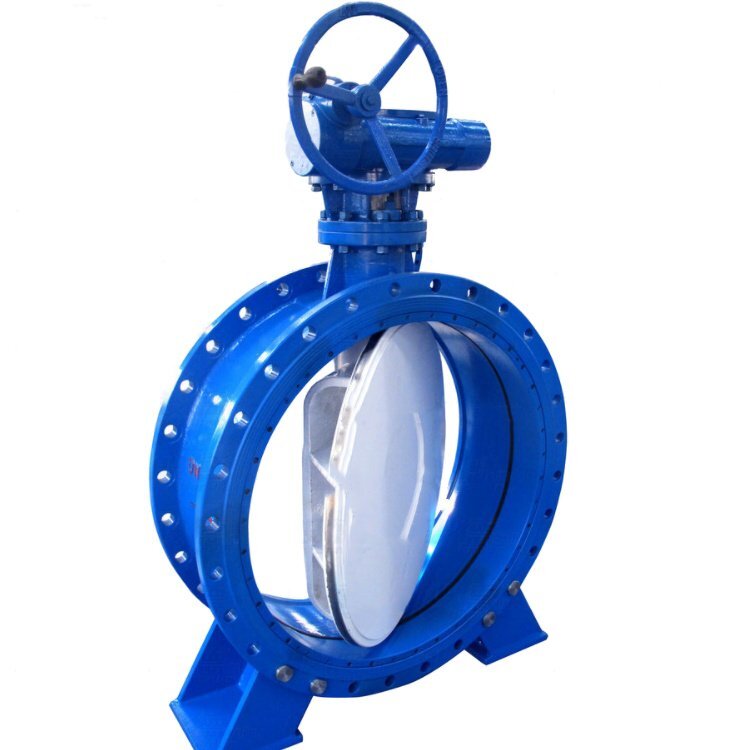
Wafer Butterfly Valve vs Double Flanged Butterfly Valve
Both structures can provide butterfly-valve isolation, but their connection methods create different installation characteristics.
| Consideration | Wafer Butterfly Valve | Double Flanged Butterfly Valve |
|---|---|---|
| Body length | Compact | Generally longer |
| Valve weight | Usually lower | Usually higher |
| Pipeline connection | Clamped between flanges | Valve has flanges on both sides |
| Installation alignment | Highly dependent on surrounding flanges | More defined flange-to-flange connection |
| Space requirement | Lower | Higher |
| Large pipeline structural connection | Depends strongly on installation arrangement | Often more robust as a separate flanged component |
The wafer design is attractive when space, weight, and compact installation are priorities. A double-flanged design may be more suitable where the valve needs a more defined mechanical connection to each side of the pipeline.
Neither structure is automatically better; the correct choice depends on how the valve fits into the complete piping system.
RMT Wafer Butterfly Valve for Pipeline Applications
RMT provides a dedicated Ductile Cast Iron Wafer/LT Butterfly Valve product intended for pipeline isolation and regulation. The individual product page identifies wafer butterfly valve construction with resilient sealing and lists options for different body, disc, shaft, and seat materials. The product range also covers multiple sizes and pressure configurations for different pipeline requirements.
In practical applications, the suitable Wafer Butterfly Valve configuration should be considered together with pipe diameter, flange dimensions, pressure conditions, medium, operating method, disc clearance, and installation environment. The RMT product page also emphasizes the compact structure and quarter-turn operation associated with this valve design.
Rather than looking only at DN and pressure rating, a more complete installation relationship is:Valve Size + Flange Compatibility + Disc Clearance + Alignment + Operating Torque
FAQ
1. What Is a Wafer Butterfly Valve?
A Wafer Butterfly Valve is a compact butterfly valve installed between two pipeline flanges. The surrounding flange bolts or studs hold the valve in position while the rotating disc controls or isolates flow.
2. Why Must a Wafer Butterfly Valve Be Centered Correctly?
Correct centering helps maintain sufficient disc clearance and keeps the disc, resilient seat, and pipeline bore in the intended geometric relationship.
3. Can Flange Bolts Be Used to Correct Pipe Misalignment?
They should not be relied on to correct major misalignment. Pulling misaligned flanges together through bolt force can introduce additional stress and affect valve operation.
4. Is a Wafer Butterfly Valve Suitable for Flow Regulation?
It can be used for many general regulating duties, but flow response is nonlinear. Precision control applications require additional evaluation of pressure drop, velocity, cavitation, and control accuracy.
Conclusion
A Wafer Butterfly Valve offers a compact and efficient way to provide pipeline isolation and flow regulation, but the same compact structure makes installation geometry especially important. Flange alignment, valve centering, disc clearance, seat compression, pipe support, and operating torque all influence whether the valve can perform as intended.
For this reason, the most useful evaluation is not simply whether the valve fits between two flanges. A properly applied Wafer Butterfly Valve should have enough room for unrestricted disc movement, maintain controlled seat contact, and operate without using the valve body to compensate for pipeline misalignment or unsupported loads.
When these conditions are considered together, the compact wafer structure can provide reliable service without sacrificing the mechanical integrity of the surrounding pipeline.
Post time: Sep-01-2026