




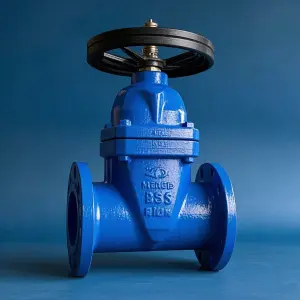
A Wedge Gate Valve is a common pipeline isolation valve widely used in water supply, drainage, wastewater treatment, fire protection, industrial water systems, pump stations, and municipal pipeline engineering. Its main function is to fully open or fully close the pipeline, allowing operators to stop or restore fluid transportation when a pipeline section, pump, valve group, or treatment unit needs to be controlled.
Unlike valves mainly designed for flow regulation, a Wedge Gate Valve is more suitable for on-off service. When the valve is fully open, the gate moves out of the flow path, allowing fluid to pass through the valve body with relatively low resistance. When the valve is closed, the wedge-shaped gate moves downward into the seat area and forms a tight shutoff. This simple but strong structure makes it suitable for many pipeline systems that require reliable isolation and long service life.
For engineering buyers, the key question is not only “What is a Wedge Gate Valve?” but also “In which applications does it perform better than other valve types?” In water pipeline projects, the answer usually depends on pipe size, pressure, installation position, operation frequency, maintenance method, and sealing requirements.
Why Is the Wedge Structure Important?
The core feature of a Wedge Gate Valve is its wedge-shaped gate. The gate moves up and down inside the valve body. When the valve is closed, the wedge gate presses against the seats on both sides, creating a sealing effect.
This structure brings several practical advantages:
- The wedge shape helps create tighter contact with the valve seats;
- The valve is suitable for complete pipeline shutoff;
- The flow path is relatively open when the valve is fully open;
- The structure is suitable for larger pipeline sizes;
- The design is mature and widely used in water engineering projects.
In many water supply and drainage pipelines, the valve may remain fully open for a long time and only close during maintenance, repair, testing, or emergency isolation. A Wedge Gate Valve is suitable for this working condition because it is designed for stable full-open and full-close operation.
Full Open and Full Close Are the Correct Working Modes
One point buyers need to understand is that a Wedge Gate Valve is usually not used as a throttling valve. It is not suitable for staying half-open for a long time to regulate flow. If the gate remains partially open for long periods, high-speed water may pass around the gate edge, causing vibration, erosion, noise, and seat damage.
A more suitable working mode is:
- Keep the valve fully open during normal pipeline operation;
- Fully close the valve when isolation is required;
- Avoid long-term half-open operation;
- Choose other valve types if frequent flow regulation is required.
This is different from some control valves or butterfly valves, which may be used for certain regulating conditions. A Wedge Gate Valve is mainly selected when a project requires reliable shutoff and lower flow resistance in the fully open position.
The Role of Wedge Gate Valves in Pipeline Zoning Management
In municipal water supply and drainage systems, pipelines are often not a simple straight line. They are usually composed of main lines, branch lines, pump stations, valve chambers, treatment equipment, and end-user networks. As the pipeline network expands, operators need to inspect, switch, or maintain certain areas without affecting the operation of the entire system. In such scenarios, the Wedge Gate Valve mainly serves as a zoning isolation valve.
When a section of pipeline needs repair, operators can close the corresponding Wedge Gate Valve to isolate the problem section from the system. This can reduce the affected water supply area, lower the amount of water discharge during maintenance, and reduce operational risks. For urban water supply networks, industrial park water systems, and wastewater treatment projects, this zoning control capability is very important because it directly affects maintenance efficiency and service continuity.
In actual engineering projects, Wedge Gate Valves are often arranged at main pipeline nodes, branch entrances, upstream and downstream sides of pump stations, equipment maintenance points, and pipeline zoning boundaries. They may not be operated frequently every day, but when maintenance, expansion, or emergency handling is needed, they must be able to close reliably. Therefore, the value of a Wedge Gate Valve is not reflected in frequent flow regulation, but in stable isolation at critical moments.
What Is the Value of a Full-Bore Design for Pipeline Operation?
An important feature of a Wedge Gate Valve is that when it is fully open, the gate moves out of the flow path, so the pipeline can maintain a relatively smooth flow condition. For long-term water pipeline operation, the flow resistance of a fully open valve is very important because any unnecessary resistance increases system energy consumption, especially in long-distance water transmission or pump-pressurized systems.
If the internal structure of a valve continuously obstructs water flow, it may cause the following problems:
- Increased pipeline pressure loss;
- Higher pump operating load;
- Noticeable local velocity changes;
- Increased pipeline noise or vibration;
- Higher long-term operating costs.
A Wedge Gate Valve is more suitable as a low-resistance isolation valve in the fully open position. It does not continuously affect flow like some valve structures where the disc remains in the flow path, so it is suitable for main pipelines, transmission lines, and systems that need to remain open for long periods.
Why Is It Often Used in Water Supply Systems?
Water supply pipelines usually require valves that can remain open for a long time while minimizing flow resistance. When maintenance is needed, the valve must also close reliably to isolate the related pipeline section.
A Wedge Gate Valve meets this requirement because, in the fully open position, the gate is lifted out of the flow path, allowing water to pass through the valve body more smoothly. Compared with some valve structures where the disc remains in the flow path, it reduces obstruction to water flow.
For water supply systems, this can bring practical value:
- Lower pressure loss during normal operation;
- Easier isolation of pipeline sections;
- Reliable shutoff for repair or inspection;
- Suitable installation in underground valve chambers;
- Good compatibility with large-diameter pipeline layouts.
For municipal water supply networks, these advantages are important because the system usually needs continuous operation, while on-site maintenance space may be limited.
Application of Wedge Gate Valves in Drainage and Wastewater Projects
In drainage and wastewater systems, valves usually face more complex working conditions than clean water pipelines. The medium may contain sediment, suspended particles, or organic matter. A Wedge Gate Valve can be used in many wastewater-related applications, but selection should consider the medium condition, valve structure, seat design, and maintenance requirements.
For wastewater projects, buyers should pay attention to:
- Whether the valve body and coating are suitable for corrosion risks;
- Whether the sealing structure can adapt to the actual medium;
- Whether the installation position allows future maintenance;
- Whether large solids may affect gate movement;
- Whether the valve will be operated frequently or only occasionally.
In many wastewater treatment plants and drainage networks, Wedge Gate Valves are mainly used for isolation rather than frequent operation. They help operators separate pipelines, tanks, pumps, or equipment during maintenance.
How Wedge Gate Valves Are Used in Pump Stations and Water Treatment Plants
In pump stations and water treatment plants, Wedge Gate Valves are usually not used alone. They often work together with pumps, check valves, butterfly valves, expansion joints, strainers, and pipe fittings to form a complete piping system. Their role is more focused on equipment isolation and maintenance control.
For example, installing Wedge Gate Valves before and after a pump allows operators to close the related pipe sections when the pump needs maintenance, avoiding shutdown of the entire system. Installing gate valves between different treatment units in a water treatment plant can help switch process sections, so one unit can be maintained without affecting other units. In wastewater treatment systems, Wedge Gate Valves can be used to isolate channels, tanks, or equipment branches for cleaning and repair.
This application logic emphasizes system operation convenience rather than the opening and closing action of a single valve. For engineering buyers, selecting a Wedge Gate Valve requires considering its position in the whole pipeline system and whether it can truly provide maintenance isolation after closing.
What Is the Difference Between a Wedge Gate Valve and a Butterfly Valve?
Both Wedge Gate Valves and Butterfly Valves are used in water pipeline systems, but they have different advantages.
A Wedge Gate Valve has a more open flow path when fully open and is commonly used for pipeline isolation. It is suitable for positions where low flow resistance and reliable full shutoff are important.
A Butterfly Valve has a more compact and lightweight structure, especially for large-diameter pipelines. It is easier to install in limited spaces and can also be used in some applications that require more frequent operation or flow control.
A simple comparison is as follows:
- Wedge Gate Valve: more suitable for full-open/full-close isolation and low flow obstruction;
- Butterfly Valve: more suitable for compact installation and some control applications;
- Wedge Gate Valve: commonly used in underground water supply networks;
- Butterfly Valve: commonly used in plant rooms, pump stations, and space-limited systems.
The final selection should depend on project design, pipeline size, operation frequency, installation space, and shutoff requirements.
FAQ
1. What is a Wedge Gate Valve mainly used for?
A Wedge Gate Valve is mainly used for fully opening or fully closing a pipeline. It is commonly used as an isolation valve in water supply, drainage, wastewater, fire protection, and industrial pipeline systems. It is suitable for staying open for long periods and closing during maintenance, repair, or emergency conditions.
2. Can a Wedge Gate Valve be used for flow regulation?
It is not recommended for long-term throttling. A Wedge Gate Valve should usually be fully open or fully closed because partial opening may cause water erosion, vibration, noise, and seat damage. If the project requires frequent flow regulation, a valve type more suitable for regulating service should be considered.
3. Is a Wedge Gate Valve suitable for underground pipeline networks?
Yes. Wedge Gate Valves are commonly used in underground water supply networks and valve chambers, especially where pipeline section isolation and long-term stable operation are required. However, underground installation should consider operation space, valve chamber maintenance conditions, anti-corrosion protection, and future inspection convenience.
4. What should be considered when selecting a Wedge Gate Valve?
When selecting a Wedge Gate Valve, buyers should consider pipe diameter, working pressure, medium type, installation position, operation frequency, whether it is used for zoning isolation, whether low-resistance operation is required, and whether the site is convenient for later maintenance. For large-diameter valves or deep valve chamber installation, a gearbox, extension stem, or electric actuator may also be considered.
Conclusion
A Wedge Gate Valve is a reliable isolation valve for water supply, drainage, wastewater, fire protection, and industrial pipeline systems. Its wedge-shaped gate structure helps provide stable shutoff, while its full-open flow path supports smoother fluid passage and lower flow resistance.
In actual engineering applications, the value of a Wedge Gate Valve is not only reflected in the product itself, but also in pipeline zoning management, pump station maintenance, water treatment system switching, and long-term operation management. For pipeline projects that require full-open/full-close service, low-resistance operation, and reliable isolation, selecting the right Wedge Gate Valve can improve system maintainability, reduce operating risks, and support long-term stable pipeline operation.
Post time: Jul-14-2026