




An eccentric plug valve may reach its fully closed position and still allow fluid to pass through. The actuator may appear to operate normally, and the position indicator may show that the valve is closed, yet the pipeline continues to experience leakage. This usually indicates that the valve’s actual sealing condition does not meet the required shutoff performance. The cause may involve contamination, sealing-surface damage, incomplete travel, unsuitable operating conditions, or installation problems.
Identify Where the Leakage Occurs
Before investigating a fault, distinguish between internal and external leakage. Internal leakage occurs when fluid continues to pass through the valve despite the closed position. External leakage occurs when fluid escapes from the valve body, stem area, flange connections, or other pressure-containing joints. Internal leakage generally directs attention toward the plug, seat, closing position, and differential pressure. External leakage requires closer examination of the relevant seals, fasteners, and connections. It is also important to establish the required leakage limit.
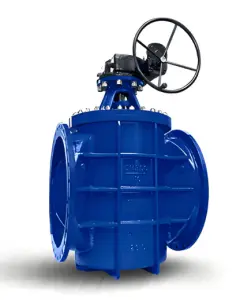
An Eccentric Plug Valve uses an offset plug movement that helps reduce continuous contact between the plug and seat during part of the operating cycle. As the valve closes, the plug moves into its sealing position. If the sealing surfaces cannot establish the intended contact, or if another part of the mechanism prevents complete closure, leakage may occur even when the valve appears to be shut.
Four Common Reasons for Internal Leakage
Debris Interferes With the Sealing Interface
Particles trapped between the plug and seat can prevent the sealing surfaces from contacting properly. This may happen in water and wastewater systems where suspended solids, sand, scale, or other deposits enter the valve. Loose debris may temporarily obstruct the sealing interface, creating a leakage path that disappears after the obstruction is removed. However, hard particles can also scratch or deform the sealing surfaces, turning a temporary problem into a recurring one.
The operating history can help distinguish these situations. Leakage that begins after a change in fluid quality or after maintenance may indicate contamination, although inspection is needed to confirm the cause. Repeatedly cycling a leaking valve is not a dependable repair strategy. If leakage persists, the valve should be isolated and depressurized before the sealing components are inspected according to the manufacturer’s maintenance instructions.
The Plug Does Not Reach Its Intended Closing Position
A closed signal does not necessarily prove that the plug has reached its designed sealing position. Incorrect travel-limit settings, a loose coupling, linkage problems, or actuator faults can prevent complete movement.
For manually operated valves, excessive resistance may stop the operator from completing the intended stroke. For automated systems, incorrect limit-switch adjustment or insufficient actuator torque may produce a similar result. Position feedback can also be misleading if it reflects the actuator’s command rather than the actual mechanical position of the plug. The actuator, travel stops, linkage, and actual valve movement should be checked against the manufacturer’s specifications. Any adjustment must follow the approved procedure to avoid overloading the mechanism or compromising safe operation.
Operating Conditions Exceed the Valve’s Intended Range
A valve that seals adequately at one pressure may leak when the operating conditions change. Differential pressure affects the forces acting on the plug and the demands placed on the sealing interface. Temperature changes can also influence component dimensions and the properties of elastomeric sealing materials.
A material suitable for one medium may deteriorate when exposed to incompatible chemicals, elevated temperatures, or abrasive particles. Deposits and corrosion products can further interfere with closure. If leakage occurs only at higher pressure, after a temperature change, or when the process medium changes, these patterns provide useful diagnostic clues. The valve’s rated pressure, temperature limits, material compatibility, and specified shutoff capability should be compared with the actual operating conditions before corrective action is selected.
Installation Stress or Component Deterioration Affects Sealing
Incorrect installation can compromise valve performance even when the internal sealing components appear serviceable. Pipe misalignment, excessive external loads, unsuitable gasket installation, or improper flange bolting may affect the integrity of the assembly. External leakage around a flange usually calls for inspection of the gasket, flange faces, fasteners, and pipe alignment. Leakage near the stem may indicate a problem with the stem sealing arrangement or another pressure-containing component. These symptoms should not automatically be attributed to the plug seat.
Internal wear is a separate possibility. Repeated operation, corrosion, damaged surfaces, or long-term exposure to unsuitable media may gradually reduce sealing effectiveness. The appropriate response depends on the condition of the affected parts and the valve’s design. Where damage exceeds the manufacturer’s repair limits, adjustment alone may not restore the required shutoff performance.
How to Diagnose the Cause Systematically
A reliable diagnosis starts with the leakage pattern and operating history rather than immediate disassembly. Record whether the leakage is internal or external, whether it occurs continuously, and whether it began after maintenance, a process change, or an extended period of inactivity.
-
Confirm the operating conditions. Record upstream and downstream pressures, temperature, fluid type, and the circumstances under which leakage occurs. Compare them with the valve’s specified operating limits.
-
Verify actual valve travel. Check the actuator, travel stops, linkage, and position feedback against the manufacturer’s instructions. Do not assume that a closed indication proves complete mechanical closure.
-
Inspect the sealing interface. If operational checks do not explain the problem, isolate and depressurize the pipeline before checking for debris, scratches, corrosion, or deformation.
-
Examine external connections. For leakage around the stem, body, or flanges, inspect the corresponding seals and pressure-containing joints instead of focusing exclusively on internal components.
These checks should be completed in a controlled sequence. A pressurized valve must never be dismantled. Any work involving internal access or removal of pressure-retaining components must follow site safety requirements and the manufacturer’s maintenance procedures.
When Is Adjustment Enough, and When Is Repair Necessary?
The correct response depends on the verified cause. If an actuator is incorrectly adjusted or the position feedback is inaccurate, correcting the setting may restore the intended closing position. If loose contamination is responsible, cleaning may be sufficient when the sealing surfaces remain undamaged and the maintenance procedure allows it.
More serious damage requires a different approach. Deep scoring, corrosion, deformation, or deterioration of sealing components may prevent the valve from meeting its specified leakage limit even after adjustment. Depending on the design, affected parts may need refurbishment or replacement. A valve that operates smoothly can still fail a shutoff test. Conversely, increased operating resistance does not automatically prove that the seat is damaged. Inspection findings and an appropriate test should guide the repair decision.
After maintenance, the valve should be tested under an approved procedure using the specified test conditions and acceptance criteria. Recording the results and repair history helps determine whether leakage has been resolved or whether the problem is recurring under particular process conditions.
Configuring an Eccentric Plug Valve for Reliable Shutoff
An Eccentric Plug Valve intended for water supply or wastewater service should be selected according to its documented design limits and the actual pipeline conditions. Seat configuration, plug and body materials, internal protection, and actuator requirements all influence suitability. Matching nominal diameter alone is not enough to establish compatibility.
For projects that require a replacement valve or a new installation, RMT offers a diverse range of eccentric plug valve product series, with variations in connection types, sizes, and pressure configurations. The company also describes options for internal protection and different component materials, depending on the series and configuration.
Conclusion
An eccentric plug valve can leak even when fully closed because debris obstructs the sealing interface, the plug does not reach its intended position, operating conditions exceed the design limits, or installation and component deterioration affect sealing performance. The most effective troubleshooting approach begins by identifying the leakage location and reviewing the conditions under which it occurs. Systematic checks of valve travel, process conditions, sealing components, and external connections help determine whether adjustment, cleaning, repair, or a configuration review is required.
FAQ
Can an eccentric plug valve leak even when the actuator indicates that it is closed?
The indication may reflect the actuator command or limit-switch status rather than the plug’s actual sealing position. The travel settings, linkage, and mechanical movement should be checked according to the manufacturer’s instructions.
Does internal leakage always mean the plug or seat must be replaced?
Debris or incorrect positioning may cause leakage without permanent damage. Inspection and appropriate testing are needed to determine whether cleaning or adjustment is sufficient or whether a component has deteriorated.
Why might a valve leak only when pipeline pressure increases?
Higher differential pressure changes the forces acting on the valve and may expose weaknesses at the sealing interface. The pressure rating, specified shutoff performance, and actual operating conditions should be reviewed before deciding on corrective action.
How can recurring leakage be reduced after maintenance?
Identify and correct the underlying cause. Verify actuator travel, inspect sealing surfaces, confirm material compatibility, and test the valve against its specified leakage criteria before returning it to service.
Post time: Oct-22-2026