




A Y-Type Strainer is commonly installed in water and industrial pipelines to intercept rust, scale, welding residue, sand, and other solid particles before they reach pumps, valves, meters, nozzles, or other downstream equipment. Its performance depends on more than screen opening size. A strainer must remove harmful debris while maintaining enough flow area to avoid excessive pressure loss.
This balance changes during operation. A clean Y-Type Strainer normally creates relatively low resistance, but as particles accumulate on the screen, the available open area decreases and differential pressure rises. For this reason, filtration performance should be evaluated through the relationship between screen opening, effective open area, debris loading, flow rate, and pressure drop, rather than by mesh size alone.
Why Does Pressure Drop Matter in a Y-Type Strainer?
Every Y-Type Strainer creates some hydraulic resistance because the fluid must change direction locally and pass through the screen openings. Even with a clean screen, these changes create a measurable pressure difference between the upstream and downstream sides.
As debris accumulates, part of the screen surface becomes blocked. The remaining openings then carry a greater proportion of the total flow, increasing local velocity and resistance. A clean screen therefore generally provides a larger effective flow area and lower pressure loss, while a loaded screen produces progressively higher differential pressure.
An increase in differential pressure can indicate several different conditions:
- Debris has accumulated on the screen;
- Solids concentration is higher than expected;
- The selected screen is too fine for the service;
- System flow rate has increased;
- Debris entered the pipeline after commissioning or maintenance.
Differential pressure should not be interpreted independently of flow rate. Higher flow naturally produces a greater pressure drop even when the screen is clean, so operating data is more useful when pressure and flow are considered together.
Why Is a Finer Y-Type Strainer Screen Not Always Better?
A smaller screen opening can capture finer particles, but that does not automatically make it the better choice. Finer filtration usually reduces available flow area and increases the possibility of rapid blockage, especially in systems with significant suspended solids.
The screen should therefore be selected according to the particle size that could actually interfere with downstream equipment. Capturing particles much smaller than the equipment requires may increase pressure loss and maintenance frequency without providing a meaningful operational benefit.
A practical screen decision should consider several factors together:
- Minimum particle size that needs to be removed;
- Expected concentration of suspended solids;
- Required pipeline flow;
- Acceptable pressure loss;
- Desired cleaning interval;
- Sensitivity of downstream equipment.
The objective is not to achieve the finest possible filtration. It is to provide sufficient protection while maintaining stable hydraulic conditions.
Screen Opening Size and Effective Open Area Are Different
Screen opening size describes the size of individual perforations or mesh openings, while effective open area describes how much total area remains available for fluid passage. These two values should not be confused.
Wires, perforated plate material, supporting structures, and collected debris all reduce the area through which fluid can actually pass. Two screens can therefore have similar filtration accuracy but very different hydraulic performance if one provides significantly more total open area.
A useful relationship is: Open Area Ratio = Effective Screen Opening Area ÷ Pipeline Flow Area
A higher open-area ratio generally reduces velocity through individual openings and provides more capacity before accumulated debris creates a significant restriction. This is why evaluating a Y-Type Strainer only by mesh size or perforation diameter gives an incomplete picture of how it will perform in the pipeline.
How Does Debris Loading Change Y-Type Strainer Performance?
Strainer blockage usually develops gradually rather than causing an immediate failure. During the early stage, particles begin collecting on the screen while the system may continue operating with little noticeable change. As more surface area becomes blocked, flow is forced through fewer openings and differential pressure increases more quickly.
If cleaning is delayed for too long, the system may experience reduced downstream flow, increased pump load, higher energy consumption, greater stress on the screen, or unstable process conditions. Heavily compacted debris may also become more difficult to remove during maintenance.
This means cleaning intervals should reflect actual contamination conditions rather than follow a fixed calendar schedule. A Y-Type Strainer operating in relatively clean treated water may remain stable for a long period, while the same type of strainer in a newly installed pipeline may collect large amounts of rust, welding residue, scale, or construction debris within a short time.
Why Does Installation Orientation Affect Y-Type Strainer Performance?
The Y-shaped branch contains the screen and provides space for collected particles. In liquid systems, the installation arrangement should allow debris to remain in the screen chamber instead of readily returning to the main flow path.
Maintenance access is equally important. A strainer may perform correctly during operation but become difficult to service if the cover or screen cannot be removed because of nearby pipework, walls, floors, or structural members.
Installation should therefore account for flow direction, screen-chamber orientation, removal clearance, pipeline support, and access for isolation. The strainer body should not be expected to carry unnecessary pipe weight, and sufficient space should remain around the branch for screen removal and cleaning.
These details directly affect whether routine maintenance can be completed without disturbing surrounding piping.
Why Can a Y-Type Strainer Influence Pump Performance?
A Y-Type Strainer can protect a pump from solid debris, but excessive strainer resistance can create a different operating problem. This is particularly important when the strainer is installed on the pump suction side.
As the screen becomes blocked, pressure at the pump inlet can decrease. If the available suction pressure becomes too low, the margin between inlet pressure and the liquid vapor pressure is reduced, increasing cavitation risk. A strainer upstream of a pump therefore has to achieve two objectives at the same time: stop harmful debris and maintain sufficiently low suction-side pressure loss.
For pump applications, both clean-screen and dirty-screen conditions should be considered. A screen that performs well when new may become unsuitable if normal debris accumulation causes the pressure drop to rise beyond what the pump system can tolerate.
Y-Type Strainer or Basket Strainer: Which Fits the Service Better?
Y-type and basket strainers perform similar protective functions, but their internal structures lead to different operating characteristics.
| Consideration | Y-Type Strainer | Basket Strainer |
|---|---|---|
| Body structure | Compact Y-shaped body | Larger collection chamber |
| Installation space | Generally smaller | Usually requires more space |
| Dirt-holding capacity | Moderate | Typically higher |
| Screen removal | Through branch cover | Basket removed from chamber |
| Typical debris load | Low to moderate | Moderate to high |
| Maintenance frequency | Depends strongly on solids loading | Often suited to larger debris volumes |
A Y-Type Strainer is often practical where installation space is limited and contamination levels are manageable. A basket strainer may be more suitable when the process generates larger amounts of debris or when longer intervals between cleaning are important. The choice should therefore be based on expected solids loading and maintenance conditions rather than body shape alone.
RMT Y-Type Strainer for Water Pipeline Applications
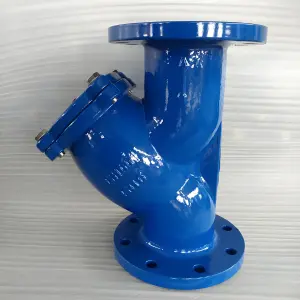
RMT provides a dedicated Y-Type Strainer for water and wastewater pipeline systems. According to the individual product detail page, the product is available in DN50–DN300 and PN10, PN16, and PN25 configurations, with EN1092-2 or ISO7005-2 flange connections. The listed structure includes a ductile iron body and cover, EPDM sealing ring, and SS304 removable filter screen.
These specifications still need to be considered together with actual operating conditions. Pipe diameter, working pressure, required particle retention, debris concentration, acceptable pressure drop, installation space, and screen-cleaning access all affect long-term performance.
For practical pipeline service, a suitable Y-Type Strainer should achieve a balance between required filtration accuracy, sufficient effective open area, acceptable pressure loss, and manageable maintenance frequency.
FAQ
1. What equipment can a Y-Type Strainer protect?
A Y-Type Strainer can help prevent solid particles from reaching pumps, valves, flow meters, nozzles, and other downstream equipment that may be affected by debris.
2. Does a smaller screen opening always provide better filtration?
Not necessarily. A smaller opening captures finer particles but can also increase pressure loss and cleaning frequency. Screen size should match the protection requirements of downstream equipment.
3. How can screen blockage be identified?
Increasing differential pressure, reduced downstream flow, or changes in equipment performance can indicate debris accumulation. Pressure readings should be interpreted together with system flow conditions.
4. Can a Y-Type Strainer be installed before a pump?
Yes, but suction-side pressure loss must remain within acceptable limits. Excessive blockage or an unnecessarily fine screen can reduce pump inlet pressure and increase cavitation risk.
Conclusion
A Y-Type Strainer should not be evaluated only by how fine its screen is. Effective filtration depends on the interaction between particle size, total open area, debris loading, flow rate, and acceptable pressure loss.
A finer screen may capture smaller particles but can also block more quickly, while a larger effective screen area can maintain flow for longer before cleaning becomes necessary. In pump systems, the balance becomes even more important because excessive strainer resistance can directly affect suction conditions.
The practical goal is therefore to select a Y-Type Strainer that removes the particles capable of affecting downstream equipment while maintaining sufficient flow area and acceptable pressure loss throughout the operating and cleaning cycle.
Post time: Aug-27-2026