




In modern fluid transmission systems, reliability and maintenance efficiency are major concerns for engineers, contractors, and infrastructure investors. The NRS Flanged Soft Seal Gate Valve has become a preferred solution in municipal water supply, industrial piping networks, and underground installations because it combines dependable sealing performance with compact structural design.
For B2B buyers and project planners, selecting the right gate valve directly influences operational safety, maintenance frequency, and total lifecycle cost. Understanding how NRS flanged soft seal gate valves perform in real working environments helps ensure stable pipeline operation over decades rather than years.
Understanding the Structure of NRS Flanged Soft Seal Gate Valve
The term NRS refers to Non-Rising Stem, meaning the valve stem rotates internally without moving upward or downward externally during operation. This design differs from rising stem valves, which require additional vertical installation space.
The flanged connection ensures secure pipeline integration, while the soft sealing mechanism provides tight shut-off even after long-term service.
● Internal rotating stem design minimizes installation height requirements
● Rubber-encapsulated gate ensures full surface sealing contact
● Flanged ends enable standardized pipeline installation
● Full bore flow channel reduces turbulence and pressure loss
● Internal stem protection improves corrosion resistance
This combination allows the valve to function reliably in underground systems, valve chambers, and locations where external stem movement is impractical.
How Soft Seal Technology Improves Performance
Traditional metal-seated gate valves rely on metal-to-metal contact, which may gradually wear and cause leakage. Soft seal technology introduces an elastic sealing layer that adapts to operating conditions.
● EPDM or NBR rubber coating compensates for minor pipeline deformation
● Bubble-tight sealing prevents water loss and energy waste
● Lower operating torque reduces manual effort or actuator load
● Improved sealing reliability under fluctuating pressure conditions
● Reduced vibration and operational noise
For water utilities and industrial operators, these advantages translate into fewer shutdowns and more predictable performance.
Key Product Advantages for B2B Projects
From a procurement perspective, NRS flanged soft seal gate valves offer operational benefits that extend beyond simple flow isolation.
● Compact design suitable for underground and buried installations
● Long service life with minimal maintenance requirements
● Excellent corrosion resistance through epoxy powder coating
● Compatibility with automated actuators and monitoring systems
● Stable sealing performance even after long idle periods
Large infrastructure projects often require valves that remain closed for months or years yet operate instantly when needed. NRS valves meet this requirement effectively.
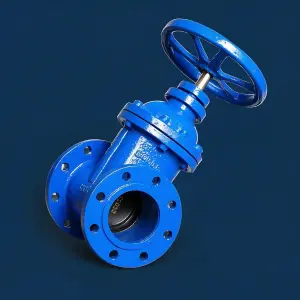
Material Configuration and Manufacturing Quality
Material selection plays a decisive role in determining valve durability and reliability in harsh environments. High-quality NRS flanged soft seal gate valves are typically manufactured using optimized material combinations.
● Ductile iron valve body providing high mechanical strength
● Stainless steel stem ensuring resistance to corrosion and wear
● Fully rubber-lined gate preventing direct metal contact
● Brass or bronze stem nut improving mechanical transmission efficiency
● Fusion-bonded epoxy coating protecting internal and external surfaces
Compliance with international standards such as EN, DIN, ISO, or AWWA ensures global compatibility for export-oriented B2B projects.
Typical Application Scenarios
NRS flanged soft seal gate valves are widely used across industries where dependable isolation is essential for safety and operational continuity.
● Municipal water distribution networks
● Wastewater and sewage treatment facilities
● Fire protection pipeline systems
● Agricultural irrigation projects
● Industrial cooling water circulation systems
● Pump stations and underground valve chambers
Their adaptability allows engineers to standardize valve selection across multiple project types, simplifying inventory management.
Installation Considerations for Optimal Operation
Even a high-quality valve requires proper installation practices to deliver maximum performance. During project execution, several factors must be carefully controlled.
● Ensure accurate flange alignment to avoid mechanical stress
● Tighten bolts evenly to maintain sealing integrity
● Install according to flow direction markings
● Allow sufficient space for maintenance access
● Perform pressure and opening tests before commissioning
Correct installation minimizes early wear and protects sealing surfaces from unnecessary damage.
Why NRS Valves Are Ideal for Underground Systems
Underground pipelines present unique challenges including limited space, moisture exposure, and difficult access. NRS flanged soft seal gate valves address these issues through structural optimization.
● No external stem movement reduces required installation height
● Fully enclosed stem prevents environmental contamination
● Durable coatings resist soil moisture and chemical exposure
● Reduced risk of accidental mechanical damage
These features make NRS valves especially popular in urban infrastructure modernization projects worldwide.
Conclusion
The NRS Flanged Soft Seal Gate Valve represents a balanced combination of engineering efficiency, operational reliability, and economic value. By integrating compact non-rising stem construction with advanced soft sealing technology, the valve provides dependable shut-off performance across municipal, agricultural, and industrial systems.
For B2B buyers, contractors, and system designers, adopting NRS flanged soft seal gate valves contributes to improved pipeline safety, lower maintenance costs, and long-term infrastructure sustainability. As global water management and industrial projects continue expanding, these valves remain a fundamental component of modern fluid control solutions.
FAQ
1. What is the main advantage of an NRS gate valve compared to a rising stem valve?
The primary advantage is the compact installation height. Because the stem does not move upward during operation, NRS valves are ideal for underground pipelines and confined spaces.
2. Are soft seal gate valves suitable for drinking water systems?
Yes. When manufactured with approved rubber materials such as EPDM and coated with food-grade epoxy, they are widely used in potable water supply networks.
3. Can NRS flanged soft seal gate valves be automated?
Absolutely. They can be equipped with electric, pneumatic, or gearbox actuators, enabling integration into modern automated pipeline control systems.
4. How long does an NRS flanged soft seal gate valve typically last?
With proper installation and periodic inspection, these valves commonly achieve service lifetimes exceeding 20 years in municipal and industrial applications.
Post time: Apr-14-2026